
Chlorosea margaretaria
Sperry, 1944
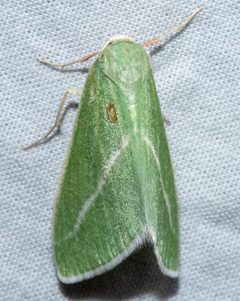
Chlorosea margaretaria is a of emerald moth in the Geometridae, first described by Sperry in 1944. It belongs to the Geometrinae, which includes many green-colored commonly known as emeralds. The species is known from North America, though specific details about its remain limited in published sources.
Pronunciation
How to pronounce Chlorosea margaretaria: /klɔːroʊˈsiːə mɑːrɡəˈriːtəriə/
These audio files are automatically generated. While they are not always 100% accurate, they are a good starting point.
Identification
As a member of the emerald moth group (Geometrinae), this likely exhibits the characteristic green coloration typical of the . Identification to species level requires examination of genitalia or detailed wing pattern characteristics, as many emerald moths are visually similar. Distinguishing features from congeneric species would require knowledge of Chlorosea .
Images
Distribution
North America. Specific range details within this region are not well documented in available sources.
Similar Taxa
- Other Chlorosea speciesCongeneric emerald moths share similar green coloration and body plan, requiring careful examination for accurate identification.
- Other Geometrinae (emerald moths)Members of this exhibit convergent green coloration and slender bodies, making visual identification challenging without detailed examination.
More Details
Taxonomic history
Described by Sperry in 1944, this remains relatively poorly known compared to more common North American geometrid moths. The Chlorosea contains few species, all restricted to western North America.
Observation data
iNaturalist records 103 observations of this , suggesting it is encountered with moderate frequency by naturalists, though it may be underreported due to identification challenges.