
Nepytia semiclusaria
(Walker, 1863)
southern nepytia, Pine Conelet Looper Moth
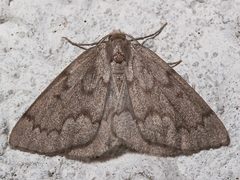
Nepytia semiclusaria, commonly known as the southern nepytia or Pine Conelet Looper , is a geometrid moth found in the southeastern United States. have a wingspan of approximately 36 mm and are active year-round. The species is associated with pine , with larvae feeding on Pinus species.
Pronunciation
How to pronounce Nepytia semiclusaria: //nɛˈpɪtiə ˌsɛmɪkluˈzeɪriə//
These audio files are automatically generated. While they are not always 100% accurate, they are a good starting point.
Identification
Distinguished from related Nepytia by its southeastern U.S. distribution; N. janetae occurs in southwestern mountain ranges. are active year-round, unlike some with more restricted periods. Larvae feed on Pinus species, whereas N. janetae larvae feed on Engelmann spruce, corkbark fir, Douglas fir, and white fir in the Southwest.
Images
Appearance
have a wingspan of approximately 36 mm. Specific wing pattern details are not documented in available sources.
Habitat
Associated with pine-dominated environments. Specific requirements beyond plant presence are not documented.
Distribution
Southeastern United States: from North Carolina to Florida, then west along the Gulf Coast.
Seasonality
are on the wing year-round.
Diet
Larvae feed on Pinus (pine) . feeding habits are not documented.
Host Associations
- Pinus - larval food plant-level association; specific pine not documented
Life Cycle
Complete with , larval, pupal, and stages. Detailed information is not available for this .
Ecological Role
Larval herbivore on pine . and ecological impacts are not documented; this species has not been associated with events unlike the related N. janetae.
Human Relevance
Not documented as an economically significant pest. The related N. janetae has caused extensive defoliation in southwestern conifer forests since 1996, but N. semiclusaria has no recorded history.
Similar Taxa
- Nepytia janetaeSimilar and general appearance, but distinguished by southwestern U.S. distribution (Arizona and New Mexico mountain ranges), winter-feeding larvae, and including Engelmann spruce, corkbark fir, Douglas fir, and white fir rather than Pinus . N. janetae has been associated with major events since 1996; N. semiclusaria has not.
More Details
Taxonomic note
The related N. janetae has been intensively studied due to dynamics, but information for N. semiclusaria remains sparse. Available sources do not indicate whether N. semiclusaria shares the winter-feeding larval documented in N. janetae.
Sources and further reading
- BugGuide
- Wikipedia
- GBIF taxonomy match
- iNaturalist taxon
- NCBI Taxonomy
- Catalogue of Life
- Nepytia janetae - Entomology Today
- Nepytia janetae defoliation - Entomology Today
- Nepytia janetae Archives - Entomology Today
- Why Has This Moth Turned Into a (Sometimes) Destructive Forest Pest?
- Ann Lynch, Ph.D. - Entomology Today