
Eusarca galbanaria
(Hulst, 1886)
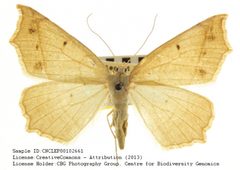
Eusarca galbanaria is a in the Geometridae, Ennominae. It is a North American with limited documented information. The Eusarca contains several species of geometrid moths, most of which are characterized by relatively plain, greenish or yellowish coloration. Available records indicate this species is present but not extensively studied.
Pronunciation
How to pronounce Eusarca galbanaria: /juˈsɑrkə ˌgælbəˈnɛriə/
These audio files are automatically generated. While they are not always 100% accurate, they are a good starting point.
Identification
Identification to level within Eusarca requires examination of genitalia characters and comparison with closely related species. External features alone are generally insufficient for reliable identification. Specimens should be compared with vouchered material and authoritative references.
Images
Appearance
are medium-sized geometrid moths. Specific coloration and wing pattern details for this are not well documented in available sources. Members of the Eusarca generally exhibit relatively uniform greenish, yellowish, or brownish forewings with subtle patterning.
Distribution
Recorded from North America. Specific range details beyond continental presence are not established in available sources.
Similar Taxa
- Eusarca falcataSimilar member with overlapping range; external appearance may be nearly identical, requiring genital dissection for separation
- Eusarca confusariaAnother congeneric with which it may be confused; distinguished by subtle differences in wing shape and male genitalia
More Details
Taxonomic Note
The was described by George D. Hulst in 1886. The Eusarca is part of the diverse geometrid Ennominae, which contains many species with conservative external that complicates field identification.
Data Limitations
This has only 41 observations on iNaturalist as of the source date, indicating it is either genuinely uncommon, underreported, or difficult to identify from photographs. Published biological information appears sparse.