
Thyrinteina arnobia
(Stoll, 1782)
eucalyptus brown looper, brown looper caterpillar
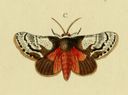
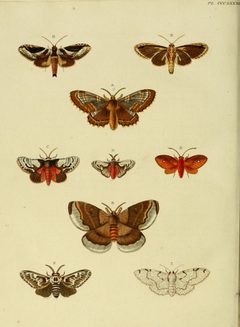
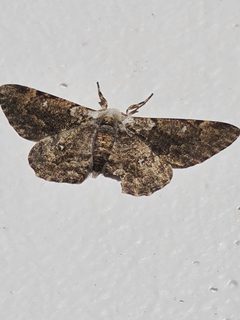
Thyrinteina arnobia is a geometrid native to the Americas and a major pest of Eucalyptus plantations in Brazil. The occurs throughout South America and parts of Central and North America, where it feeds primarily on Myrtaceae, with Eucalyptus serving as a vulnerable in commercial plantations. Larval can reduce Eucalyptus production by up to 40%, making it the primary defoliator of subtropical and tropical Brazilian eucalyptus farms. genetic studies indicate low genetic diversity in Brazil with three regional mitochondrial haplogroups, suggesting arise from local populations rather than long-distance .
Pronunciation
How to pronounce Thyrinteina arnobia: /tʰɪˈrɪntɛɪnə ˈɑrnəbiə/
These audio files are automatically generated. While they are not always 100% accurate, they are a good starting point.
Images
Habitat
Eucalyptus plantations in subtropical and tropical Brazil; native environments in tropical and subtropical areas including Atlantic Forest, Cerrado, and transition zones between Atlantic Forest and Southern Cerrado
Distribution
Native to the Americas; present throughout nearly all of South America and parts of Central and North America; in Brazil occurs across the Atlantic Forest, transition zones between Atlantic Forest and Southern Cerrado, and Northern Cerrado biomes; potential suitable areas predicted in Africa, Asia, and Oceania
Diet
Feeds primarily on members of the Myrtaceae; Eucalyptus serve as the primary in plantation settings; several native Myrtaceae species also serve as hosts
Host Associations
- Eucalyptus - primary in plantationsvulnerable ; commercial plantations drive expansion
- native Myrtaceae species - native several native utilized with preference for Myrtaceae
Life Cycle
Larvae develop through multiple instars; fifth-instar larvae have been used for dissection in toxicology studies; to second-instar molting used as developmental endpoint in 7-day laboratory
Behavior
Primary defoliator of Eucalyptus crops causing severe defoliation; associated with local or regional populations with low frequency of movement among regions or biomes; demographic and spatial expansion has been associated with the historical expansion of Eucalyptus plantations over the last 100 years; larvae lack coordinated movements when affected by toxins
Ecological Role
Agricultural and forestry pest; can reduce Eucalyptus production by up to 40%; driven by commercial plantation expansion
Human Relevance
Major economic pest of Brazilian Eucalyptus plantations; subject of transgenic control research including development of Bt Eucalyptus events expressing Cry1Ab, Cry2Aa, and Cry1Bb proteins; genetic studies conducted to understand structure and inform management strategies
Sources and further reading
- BugGuide
- Wikipedia
- GBIF taxonomy match
- iNaturalist taxon
- NCBI Taxonomy
- Catalogue of Life
- Pyramiding of cry genes in high-dose transgenic eucalyptus provides control of Thyrinteina arnobia (Lepidoptera: Geometridae) and reduces the risk of resistance.
- Genetic diversity, population structure and ecological niche modeling of Thyrinteina arnobia (Lepidoptera: Geometridae), a native Eucalyptus pest in Brazil.