
Ceratonyx
Guenée, [1858]
Species Guides
3- Ceratonyx arizonensis
- Ceratonyx permagnaria
- Ceratonyx satanaria(Horned Ceratonyx)
Ceratonyx is a of geometer moths in the Geometridae, Ennominae. The genus contains three described distributed in North America, including the southwestern United States and Mexico. The genus was established by Guenée in 1858. Species in this genus are and belong to a diverse group of commonly known as inchworms or loopers due to their characteristic larval locomotion.
Pronunciation
How to pronounce Ceratonyx: //ˌsɛrəˈtoʊnɪks//
These audio files are automatically generated. While they are not always 100% accurate, they are a good starting point.
Identification
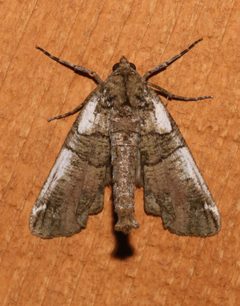
Ceratonyx can be distinguished from related geometrid by their relatively large size and distinctive wing patterns. Ceratonyx satanaria, the type species, exhibits dark, often sooty or blackish forewings with contrasting lighter markings. Ceratonyx permagnaria is notably larger than . Male are typically bipectinate (feathery), a common trait in Ennominae. Accurate identification to species level usually requires examination of genitalia .
Images
Habitat
in this occupy arid and semi-arid regions of the southwestern United States and adjacent Mexico. include desert scrub, chaparral, and oak-juniper woodlands. Elevation ranges vary by species, with some occurring in lower desert elevations and others in montane zones.
Distribution
The is restricted to North America. Ceratonyx satanaria ranges from Texas and Arizona south through Mexico. Ceratonyx permagnaria occurs in Arizona and New Mexico. Ceratonyx arizonensis is to Arizona.
Seasonality
are active primarily from late spring through early fall, with peak activity during summer months. Specific periods vary by and locality, generally corresponding to the onset of monsoon rains in desert regions.
Behavior
are and attracted to light. Like other geometrid moths, larvae move with a characteristic looping gait, arching the middle portion of the body while extending the front end forward.
Ecological Role
Larvae function as herbivores, though specific plant relationships remain poorly documented for most . serve as prey for including bats and owls, and as potential of night-blooming flora.
Human Relevance
The has no significant economic importance. are occasionally collected by lepidopterists and documented by naturalists. The specific epithet 'satanaria' reflects the dark, somewhat sinister appearance of that .
Similar Taxa
More Details
Etymology
The name Ceratonyx derives from Greek roots, likely referring to horn-like (cerato-) structures or characteristics of the or genitalia, combined with -onyx (claw or nail), though the precise etymological intent of Guenée remains undocumented.
Taxonomic History
The has remained taxonomically stable since its description, with no major revisions or synonymies published. The three have been consistently recognized in modern classifications.