
Galenara
McDunnough, 1920
Species Guides
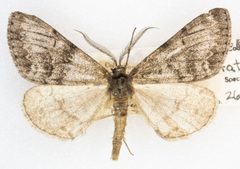
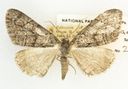
4Galenara is a of in the Geometridae, established by James Halliday McDunnough in 1920. It belongs to the Ennominae, a diverse group of geometer moths commonly known as inchworms or loopers due to their characteristic larval locomotion. The genus contains seven described , with records primarily from China. As with other Geometridae, are likely and possess the slender bodies and broad wings typical of the family.
Pronunciation
How to pronounce Galenara: //ɡəˈlɛnəɹə//
These audio files are automatically generated. While they are not always 100% accurate, they are a good starting point.
Identification
Identification to level requires examination of genitalia and wing venation patterns. The seven described within Galenara (G. consimilis, G. lallata, G. glaucaria, G. lixaria, G. lixarioides, G. stenomacra, and G. olivacea) are distinguished by subtle differences in wing pattern, coloration, and structural features. Species-level identification should be confirmed through reference to original descriptions and .
Images
Distribution
China. The has been documented in Chinese territories, though specific provincial or regional distributions for individual remain incompletely documented.
Similar Taxa
- Other Ennominae generaGalenara shares the general wing shape, body form, and resting posture typical of many Ennominae geometer moths. Differentiation requires detailed morphological examination.
- Geometridae genera with gray-green coloration epithets such as 'glaucaria' (bluish-gray) and 'olivacea' (olive-colored) suggest coloration patterns that may overlap with other geometrid .
More Details
Taxonomic history
The was established by Canadian entomologist James Halliday McDunnough (1877-1962), a prominent North American lepidopterist. Two additional were later described by Rindge in 1958. The name 'Galenara' does not appear to follow a clear etymological pattern from classical sources.
Species diversity
Seven are currently recognized: G. consimilis (Heinrich, 1931), G. lallata (Hulst, 1898), G. glaucaria (Grossbeck, 1912), G. lixaria (Grote, 1883), G. lixarioides (McDunnough, 1945), G. stenomacra (Rindge, 1958), and G. olivacea (Rindge, 1958). The specific epithet 'lixarioides' indicates similarity to G. lixaria.