
Iridopsis sanctissima
(Barnes & McDunnough, 1917)
Iridopsis sanctissima is a of geometrid described by Barnes and McDunnough in 1917. It is a member of the Ennominae, a diverse group of inchworm moths whose larvae are characterized by their distinctive looping locomotion. The species has been recorded from arid and semi-arid regions of the southwestern United States and northern Mexico. Its small size and limited distribution suggest it may be associated with specific plants in desert scrub or chaparral , though these relationships remain poorly documented.
Pronunciation
How to pronounce Iridopsis sanctissima: /ˌɪrɪˈdɒpsɪs sæŋkˈtɪsɪmə/
These audio files are automatically generated. While they are not always 100% accurate, they are a good starting point.
Identification
The MONA/Hodges number 6576 provides a unique identifier for this in North American classification systems. Distinguishing I. sanctissima from other Iridopsis species requires examination of genitalia or detailed wing pattern analysis; the species is most reliably identified by its restricted geographic range in the Mojave and Sonoran desert regions. It may be confused with other small, grayish geometrids in the same , particularly other Iridopsis species with which it is sympatric in Arizona and California.
Images
Appearance
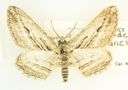
are small with forewing lengths of 15–18 mm in males and 15–20 mm in females. As a member of Iridopsis, adults likely exhibit the typical geometrid wing posture with broad, somewhat triangular forewings held flat or slightly overlapping at rest. Coloration and pattern details specific to this are not well documented in available sources. The species exhibits slight sexual size dimorphism, with females averaging marginally larger forewing lengths than males.
Habitat
Recorded from arid and semi-arid regions including Nevada, Arizona, California, and northern Baja California. The distribution pattern suggests association with desert scrub, chaparral, or dry woodland vegetation characteristic of the Mojave and Sonoran desert ecoregions. Specific microhabitat preferences are unknown.
Distribution
Central and North America. Documented occurrences include the southwestern United States (Nevada, Arizona, California) and northern Baja California, Mexico. GBIF records confirm presence in Middle America and North America.
Similar Taxa
- Other Iridopsis speciesSympatric in southwestern deserts; require genital dissection or detailed wing pattern comparison for definitive separation
- Small grayish EnnominaeSimilar size, coloration, and preference in desert regions; identification to level often requires expert examination
More Details
Taxonomic History
Originally described by Barnes and McDunnough in 1917. The Iridopsis was revised by Rindge (1966), who clarified relationships among former Anacamptodes . Some Iridopsis species, such as I. humilis, are known to feed on soybean, but no such association has been documented for I. sanctissima.
Research Needs
Basic biological information including larval plants, period, and stages remain undescribed in published literature. The is represented by only four observations on iNaturalist as of the knowledge cutoff.