
Paleacrita merriccata
Dyar, 1903
White-spotted Cankerworm Moth
A of geometrid in the Paleacrita, described by Harrison Gray Dyar Jr. in 1903. males have forewings 14–18 mm long; females are wingless. The species exhibits strong in wing development, a trait shared with other Paleacrita species.
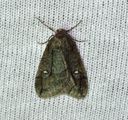
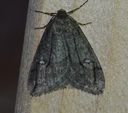
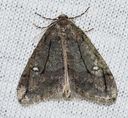
Pronunciation
How to pronounce Paleacrita merriccata: //ˌpæliˈækɹɪtə mɛˈɹɪkˌkatə//
These audio files are automatically generated. While they are not always 100% accurate, they are a good starting point.
Identification
Males can be distinguished from other Paleacrita by a combination of size (forewing 14–18 mm) and geographic distribution. The wingless condition of females is diagnostic for the but requires examination to distinguish from . The specific epithet 'merriccata' and association with white-spotted patterning in the may aid identification, though pattern details are not substantiated in primary sources.
Images
Appearance
males have forewings measuring 14–18 mm in length. Females are wingless. Specific coloration and pattern details are not documented in available sources.
Distribution
Eastern North America. Documented occurrences include central Illinois, eastern Missouri, west-central Mississippi, Louisiana, and eastern Texas.
Seasonality
males are active March through May in northern portions of the range, and January through February in the south.
Behavior
males are and attracted to light. The wingless condition of females implies limited or no capability; likely occurs via first-instar larvae ballooning on silk threads, as observed in .
Similar Taxa
- Paleacrita vernataAlso in Paleacrita with wingless females and similar early spring period; males of P. vernata may overlap in range and require careful examination for separation.
More Details
Taxonomic history
Described by Harrison Gray Dyar Jr. in 1903. The specific epithet 'merriccata' appears to be an arbitrary combination without etymological documentation in available sources.
Sexual dimorphism
The wingless female condition is a derived trait within Geometridae that has evolved independently in multiple lineages. In Paleacrita, this trait correlates with early spring when environmental conditions may favor reduced mobility in the ovipositing sex.