
Pero ancetaria
(Hübner, 1806)
Hübner's Pero Moth, Hübner's Pero
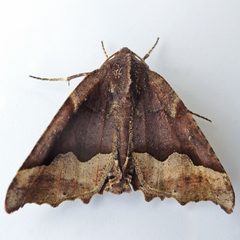
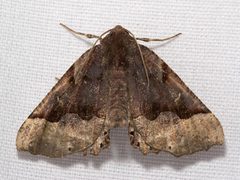
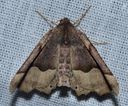
Pero ancetaria is a geometrid first described by Jacob Hübner in 1806. It is found in eastern North America, with a wingspan of 31–37 mm. The produces two per year and has been recorded from March through September in southern parts of its range.
Pronunciation
How to pronounce Pero ancetaria: /ˌpɛ.roʊ ænˈsiːt.eəri.ə/
These audio files are automatically generated. While they are not always 100% accurate, they are a good starting point.
Identification
Members of the Pero can be challenging to distinguish from one another; examination of genitalia is often required for definitive -level identification. Within its range, it may be confused with other Pero species, particularly Pero morrisonaria and Pero honestaria. The specific wing pattern and, where necessary, dissection and comparison of genitalic structures provide the most reliable means of identification.
Images
Appearance
Wingspan measures 31–37 mm. As a member of the Pero, it exhibits the characteristic wing shape and patterning typical of this group within Geometridae.
Habitat
Specific preferences are not well documented in available sources. Like many geometrid moths, it likely occupies wooded or shrubby environments where its larval plants occur.
Distribution
Eastern United States, plus Ontario and Quebec in Canada. Records indicate presence in Vermont and other northeastern states.
Seasonality
are active from March to September in the southern portion of the range. In the north, occurs from May to June and again from August to September. Two per year.
Diet
Larvae feed on Alnus (alders), Shepherdia canadensis (Canada buffaloberry), Prunus serotina (black cherry), and Salix (willows). feeding habits are not documented.
Host Associations
- Alnus - larval
- Shepherdia canadensis - larval
- Prunus serotina - larval
- Salix - larval
Life Cycle
, with two per year. Larval stage feeds on the documented plants. and details are not specified in available sources.
Ecological Role
Larval herbivore on woody plants. Specific ecological functions beyond herbivory are not documented.
Human Relevance
No significant documented interactions with humans. Not known as an agricultural or forestry pest.
Similar Taxa
- Pero morrisonariaOverlapping range and similar ; requires careful examination or genitalic dissection for separation
- Pero honestariaSympatric in parts of eastern North America; distinguished by wing pattern details and genitalic structure
More Details
Nomenclature
The specific epithet ancetaria and 'Hübner's Pero' both reference the original describer, Jacob Hübner.
Research Status
Despite being described over two centuries ago, detailed biological studies of this remain limited. Most information derives from collection records and regional faunal surveys rather than dedicated research.
Sources and further reading
- BugGuide
- Wikipedia
- GBIF taxonomy match
- iNaturalist taxon
- NCBI Taxonomy
- Catalogue of Life
- Why Honey Is Neither Bee Vomit Nor Bee Barf | Bug Squad
- They Quickly Learned What All the Buzz Was About | Bug Squad
- Spectroscopy Opens Potential for Ultra-Early Pest Detection in Crops
- Bad Roommates: Study Tracks Mice to Nests, Finds Ticks Aplenty
- A New Guide for Tick Researchers on Working With Mice
- Veterinary Medicine Offers Potential as New Tool to Reduce Lyme Disease