
Archiearis
Hübner, [1823]
orange underwing moths
Species Guides
1- Archiearis infans(Infant Moth)
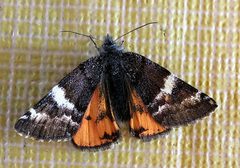
Archiearis is a of Geometridae distributed across northern Nearctic and Palearctic regions. in this genus are notable for their activity—unusual among geometrids—and their striking wing coloration featuring camouflaged patterns at rest and bright orange signals in . The genus includes five described species, most commonly referred to as orange underwings or infant moths.
Pronunciation
How to pronounce Archiearis: //ˌɑːkɪˈeə.rɪs//
These audio files are automatically generated. While they are not always 100% accurate, they are a good starting point.
Identification
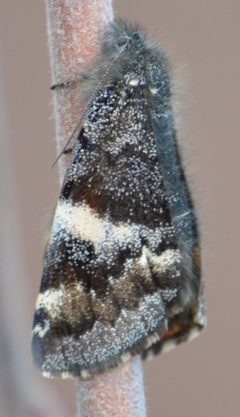
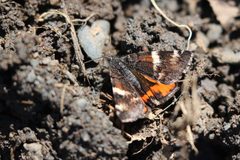
Members of Archiearis can be recognized by their orange underwing coloration visible in , a trait reflected in for several . The is distinguished from other Geometridae by its habit and associated visual defense system. At rest, wings display camouflaged patterns that conceal the bright orange upperwing surfaces.
Images
Distribution
Northern Nearctic and Palearctic regions. Documented from Denmark, Norway, Sweden, and the northeastern United States (Vermont).
Seasonality
Early spring period. Activity timing overlaps with and is shorter than that of sympatric such as Aglais urticae.
Behavior
activity—an unusual trait among geometrid moths, which are predominantly . Resting posture conceals bright wing surfaces; flight reveals orange signal coloration. defense has shifted from the ultrasonic hearing typical of nocturnal geometrids to visual defenses presumably functional against avian predators.
Similar Taxa
- Aglais urticaeConvergent wing coloration with bright orange signals in and camouflaged patterns at rest; both fly in early spring in northern Palearctic regions and occur sympatrically. Unlike Archiearis, Aglais is distasteful to birds and has a longer flight period and broader range.
More Details
Evolutionary shift to diurnality
Archiearis has evolved from geometrid ancestors. This transition involved a fundamental change in defense strategy, from ultrasonic hearing effective against bats to visual defenses presumably targeting birds.