
Mathildana
Clarke, 1941
Newman's mathildana moth
Species Guides
2- Mathildana flipria
- Mathildana newmanella(Newman's Mathildana Moth)
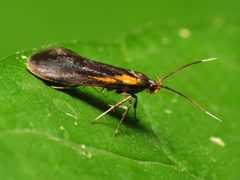
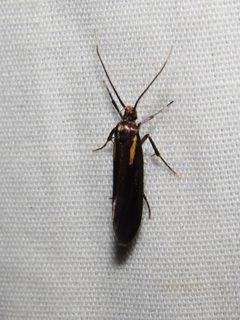
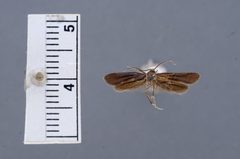
Mathildana is a of concealer moths in the Oecophoridae, established by Clarke in 1941. The genus contains at least three described , including Mathildana newmanella (Newman's mathildana moth), Mathildana filpria, and Mathildana flipria. These small are found in North America and are occasionally mistaken for fairy moths (family Adelidae) due to superficial similarities in coloration.
Pronunciation
How to pronounce Mathildana: /mɑːˈθɪl.də.nə/
These audio files are automatically generated. While they are not always 100% accurate, they are a good starting point.
Identification
Mathildana can be distinguished from superficially similar fairy moths (Adelidae) by their : Mathildana has relatively unremarkable antennae that are not dramatically elongated, whereas male Adelidae have antennae up to three times the length of their forewings and females have antennae about twice the forewing length. The antennae of Mathildana lack the extreme and exaggerated length characteristic of fairy moths.
Images
Distribution
Recorded from the eastern United States, with specific records from Vermont and Missouri. The appears to be widespread in eastern North America based on available specimen and observation data.
Seasonality
Mathildana newmanella has been observed in April, suggesting spring activity for at least some in the .
Similar Taxa
- Adelidae (fairy moths)Similar coloration and small size, but distinguished by length—Adelidae males have antennae up to 3× forewing length, females ~2× forewing length, versus unremarkable antennae in Mathildana
Misconceptions
Mathildana newmanella is sometimes mistaken for fairy moths (Adelidae) by observers due to similar coloration and small size, but belongs to the Oecophoridae, not Adelidae.
More Details
Taxonomic note
The was established by Clarke in 1941. boundaries within the genus may require clarification, as Mathildana filpria and Mathildana flipria appear to represent the same species with variant spellings (filpria vs. flipria), both attributed to Hodges, 1974.
Observation data
The has accumulated over 1,500 observations on iNaturalist, indicating it is encountered with some frequency by naturalists in its range.