
Exoteleia pinifoliella
(Chambers, 1880)
pine needleminer, pine needle miner
Exoteleia pinifoliella is a gelechiid commonly known as the pine needleminer. Native to eastern North America, it is a persistent pest of hard pines, with larvae that mine within needles. The exhibits strong site fidelity, with moths returning to the same trees to oviposit year after year, resulting in patchy, localized in forest stands. It completes one annually.
Pronunciation
How to pronounce Exoteleia pinifoliella: /ˌɛksoʊtəˈlaɪə ˌpɪnɪˌfoʊliˈɛlə/
These audio files are automatically generated. While they are not always 100% accurate, they are a good starting point.
Identification
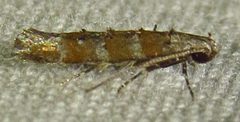
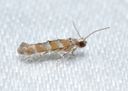
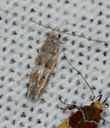
Distinguished from similar gelechiid moths by the three white fascia on forewings with characteristic brown marginal forming minute raised tufts, particularly near the fold along the second fascia. The combination of brownish-yellow ground color with fuscous flecking and specific fascia pattern is diagnostic. Similar pine-feeding Exoteleia may require dissection or molecular methods for definitive separation.
Images
Habitat
Pine forests; infests trees of all ages from nursery transplant beds to mature forest stands. Occupies forested environments where hard pines (Pinus spp.) occur.
Distribution
Eastern North America, from Southern Ontario southward through the Atlantic States to Georgia. Records from Canada and United States.
Seasonality
One per year. active during summer; larvae present in needles through fall and winter. Specific adult period not documented in available sources.
Diet
Larvae feed on hard pines (Pinus spp.), specifically documented on jack pine (Pinus banksiana) and pitch pine (Pinus rigida).
Host Associations
- Pinus banksiana - larval food plantjack pine
- Pinus rigida - larval food plantpitch pine
- Pinus - larval food plantvarious hard pines
Life Cycle
One per year. laid on pine needles. Larvae mine within needles, feeding internally. Larvae spend winter within mined needles. In spring, larvae bore into additional needles. occurs within the final mine.
Behavior
exhibit strong site fidelity, returning to oviposit on the same trees year after year. This produces localized where adjacent areas may remain uninfested for years despite suitable presence.
Ecological Role
Herbivore; acts as a persistent pest of pine forest trees. Localized structure creates patchy damage patterns within forest stands.
Human Relevance
Economic pest of pine forests and nurseries. can affect trees from nursery transplant beds to mature stands, causing localized damage. Not known to be of medical or agricultural significance beyond forestry contexts.
Similar Taxa
- ExoteleiaOther in Exoteleia are also pine needle miners with similar habits and appearance; definitive identification often requires examination of genitalia or molecular data.
- Other pine needle minersAt least six other pine needle miner occur in North America; separation requires detailed morphological or molecular study.
More Details
Oviposition Behavior
show persistent site fidelity, with females returning to the same individual trees across multiple years. This creates a mosaic pattern where heavily damaged trees may stand immediately adjacent to unaffected trees.