
Exoteleia anomala
Hodges, 1986
ponderosa pine needle miner
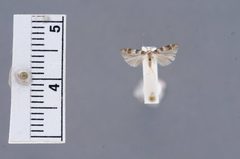
Exoteleia anomala, commonly known as the ponderosa pine needle miner, is a small gelechiid whose larvae feed on the needles of Pinus ponderosa. The is restricted to the southern United States, with confirmed records from Alabama, Louisiana, Mississippi, New Mexico, and Arizona. are active from spring through autumn, with forewings measuring 4–5 mm in length.

Pronunciation
How to pronounce Exoteleia anomala: /ˌɛksoʊˈtɛliə əˈnɒmələ/
These audio files are automatically generated. While they are not always 100% accurate, they are a good starting point.
Identification
The specific forewing length of 4–5 mm provides a measurable characteristic for identification. The can be distinguished from other Exoteleia species by its association with Pinus ponderosa as the larval and its restricted geographic distribution in the southern United States. Accurate identification likely requires examination of genitalia or molecular analysis given the morphological similarity among many gelechiid species.
Images
Appearance
are small with forewings 4–5 mm in length. As a member of the Gelechiidae, the likely exhibits the typical narrow, pointed wing shape and relatively slender body form characteristic of this family, though specific coloration and pattern details are not documented in available sources.
Habitat
Associated with stands of Pinus ponderosa (ponderosa pine), the larval plant. The occupies pine forest environments within its southern U.S. range.
Distribution
United States: recorded from Alabama, Louisiana, Mississippi, New Mexico, and Arizona. The distribution corresponds to the range of its plant, Pinus ponderosa, in the southern United States.
Seasonality
are on wing from April to October, indicating a multi-month period spanning spring through autumn.
Diet
Larvae feed on the needles of Pinus ponderosa. feeding habits are not documented.
Host Associations
- Pinus ponderosa - larval food plantlarvae feed on needles
Life Cycle
Complete with , larva, pupa, and stages. Larval development occurs within ponderosa pine needles. Specific details regarding number of per year, stage, and site are not documented.
Behavior
are active during daylight hours given their period. Larvae are needle miners, feeding internally or externally on pine needles. No other behavioral details are documented.
Ecological Role
As a herbivore on Pinus ponderosa, the contributes to the natural herbivore load on this pine species. The ecological impact is likely minor given the restricted distribution and apparently localized .
Human Relevance
No direct economic or human health significance is documented. The is not known to be a significant forestry pest, though localized damage to ornamental or plantation ponderosa pines is possible.
Similar Taxa
- Other Exoteleia speciesMorphologically similar gelechiid moths in the same ; differentiation requires plant association and geographic distribution data, along with detailed morphological or molecular analysis
More Details
Taxonomic history
Described by Hodges in 1986, indicating relatively recent formal taxonomic recognition
Sources and further reading
- BugGuide
- Wikipedia
- GBIF taxonomy match
- iNaturalist taxon
- Catalogue of Life
- Blossom busters: Oriental beetle, Anomala orientalis — Bug of the Week
- Blossom buster: Oriental beetle, Anomala orientalis — Bug of the Week
- Chafer madness: Oriental beetle, Anomala orientalis, and Asiatic garden beetle, Maladera castanea — Bug of the Week
- Archive — Bug of the Week
- Ascalaphidae | Beetles In The Bush
- August | 2022 | Beetles In The Bush