
Coleotechnites macleodi
(Freeman, 1965)
brown hemlock needleminer
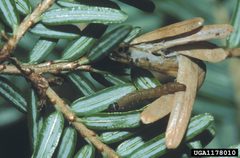
A small gelechiid known for its specialized relationship with eastern hemlock. The refers to its larval habit of mining within hemlock needles. It completes one annually in its northern range.
Pronunciation
How to pronounce Coleotechnites macleodi: /ˌkɒliːoʊˈtɛknaɪtiːz ˌmækˈlɛˌoʊdaɪ/
These audio files are automatically generated. While they are not always 100% accurate, they are a good starting point.
Identification
Distinguished from other Coleotechnites by association with Tsuga canadensis as ; confirmed identification requires examination of genitalia or larval . Similar in the may utilize different conifer hosts.
Images
Appearance
Wingspan 9–11 mm. Specific coloration and pattern details are not documented in available sources.
Habitat
Forests and wooded areas where eastern hemlock (Tsuga canadensis) occurs, typically in mesic to wet-mesic conditions with mature hemlock stands.
Distribution
Northeastern United States and Canada. GBIF records confirm presence in both countries.
Seasonality
One per year; timing not specified in sources but likely synchronized with .
Diet
Larvae feed on Tsuga canadensis (eastern hemlock), mining within needles.
Host Associations
- Tsuga canadensis - larval eastern hemlock
Life Cycle
(one per year). Larval development occurs within hemlock needles; and timing not specified.
Behavior
Larvae are needle miners, feeding internally within hemlock foliage. are presumably , consistent with characteristics, though direct observations are not documented.
Ecological Role
Specialized herbivore of eastern hemlock; impacts on trees are not documented but likely minor given the 's small size and localized feeding.
Human Relevance
No documented economic or conservation significance; presence may serve as an indicator of intact hemlock .
Similar Taxa
- Other Coleotechnites speciesMany are conifer needle miners; differentiation requires association and morphological examination.
More Details
Original Description
Originally described as Pulicalvaria macleodi by Freeman in 1965, later transferred to Coleotechnites.