
Coleotechnites atrupictella
(Dietz, 1900)
Spruce Micromoth
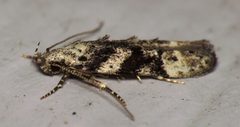
A small gelechiid with a wingspan of 9–10 mm, recognized by its distinctive blackish forewing fasciae. The larvae are folivores on conifers, feeding on spruce, pine, hemlock, Douglas-fir, and subalpine fir. The is , with active from April to September and larvae present in June and July. It overwinters as an .
Pronunciation
How to pronounce Coleotechnites atrupictella: //ˌkoʊliːoʊtɛkˈnaɪtiːz ˌætruːpɪkˈtɛlə//
These audio files are automatically generated. While they are not always 100% accurate, they are a good starting point.
Identification
Distinguished from similar Coleotechnites by the specific arrangement of forewing fasciae: first fascia oblique from at one-fifth, second broad and less oblique before middle, third narrower and slightly oblique at less than two-thirds length, with a continuous stripe running through the second and third fasciae. The combination of small size (9–10 mm wingspan), pale cinereous hindwings, and this particular blackish pattern is diagnostic. Larval identification supported by reddish body with greenish-brown and association with conifer .
Images
Habitat
Coniferous forests and woodlands supporting trees including black spruce, Engelmann spruce, red spruce, white spruce, lodgepole pine, ponderosa pine, western hemlock, Douglas-fir, and subalpine fir.
Distribution
North America: recorded from Alberta, British Columbia, Saskatchewan, Washington, Indiana, Maine, Massachusetts, Michigan, New Brunswick, Newfoundland, New York, Ontario, and Pennsylvania.
Seasonality
on wing April to September. Larvae present June and July. with one per year. Overwinters as .
Diet
Larvae feed on leaves of conifers: Picea mariana (black spruce), Picea engelmannii (Engelmann spruce), Picea rubens (red spruce), Picea glauca (white spruce), Pinus contorta (lodgepole pine), Pinus ponderosa (ponderosa pine), Tsuga heterophylla (western hemlock), Pseudotsuga menziesii (Douglas-fir), and Abies lasiocarpa (subalpine fir).
Host Associations
- Picea mariana - larval food plant
- Picea engelmannii - larval food plant
- Picea rubens - larval food plant
- Picea glauca - larval food plant
- Pinus contorta - larval food plant
- Pinus ponderosa - larval food plant
- Tsuga heterophylla - larval food plant
- Pseudotsuga menziesii - larval food plant
- Abies lasiocarpa - larval food plant
Life Cycle
stage overwinters. Larvae feed on conifer leaves during June and July. presumably follows larval development. emerge and are active April to September. with one annually.
Behavior
Larvae are folivorous on conifer needles. No other specific documented in available sources.
Ecological Role
Larval herbivore on conifer foliage; contributes to nutrient cycling and serves as potential food source for .
Human Relevance
Minor potential as forest pest given larval feeding on economically important conifer ; no significant documented economic impact.
Similar Taxa
- Other Coleotechnites speciesShare small size, gelechiid , and conifer-associated larvae; distinguished by specific forewing fasciae pattern and arrangement
More Details
Original description
Originally described as Eucordylea atrupictella by Dietz in 1900, later transferred to Coleotechnites.
Observation frequency
Over 1,000 observations recorded on iNaturalist, indicating it is relatively well-documented for a micromoth.