
Carpatolechia notatella
(Hübner, 1813)
sallow-leaf groundling
A small gelechiid with a wingspan of 12–16 mm, distributed across most of Europe (excluding the Iberian and most of the Balkan Peninsula) and Turkey. fly in late spring, while larvae are active in late summer and feed on willow leaves. The is closely associated with Salix species as larval .

Pronunciation
How to pronounce Carpatolechia notatella: /kɑːrpətoʊˈlɛkiə noʊtəˈtɛlə/
These audio files are automatically generated. While they are not always 100% accurate, they are a good starting point.
Identification
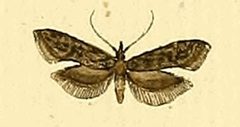
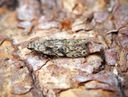
Distinguished from similar Carpatolechia by the specific arrangement of black dots and stigmata on the forewing: first discal stigma beyond plical, preceded by a black dot, with an additional black dot beneath the second discal stigma. The pattern of darker spots on the (near base, before and beyond middle) and tornus is diagnostic. Terminal palpal joint equal in length to second joint.
Images
Appearance
Wingspan 12–16 mm. whitish, sprinkled with grey. Terminal joint of labial palpus as long as second joint. Forewings whitish-grey with brownish tinge in disc, suffusedly irrorated with dark grey with scattered black scales; darker spots on near base and before and beyond middle, and on tornus; black dot at base of dorsum, two black dots in disc near base; stigmata black, first discal beyond plical, preceded by a black dot, another black dot beneath second discal. Hindwings grey. Larva pale grey-greenish with black head and black plate of segment 2.
Distribution
Most of Europe except the Iberian Peninsula and most of the Balkan Peninsula; Turkey. Records confirmed from Belgium (Flemish Region, Walloon Region, Brabant province).
Seasonality
on wing May to June. Larvae present August to September.
Diet
Larvae feed on parenchyma on the underside of leaves of Salix : Salix caprea, Salix aurita, Salix petrandra, Salix cinerea, Salix repens, and Salix alba. diet not recorded.
Host Associations
- Salix caprea - larval plantlarvae feed on leaf parenchyma
- Salix aurita - larval plantlarvae feed on leaf parenchyma
- Salix petrandra - larval plantlarvae feed on leaf parenchyma
- Salix cinerea - larval plantlarvae feed on leaf parenchyma
- Salix repens - larval plantlarvae feed on leaf parenchyma
- Salix alba - larval plantlarvae feed on leaf parenchyma
Life Cycle
Larval stage August to September, feeding on willow leaves. May to June. details not recorded.
Behavior
Larvae feed on the underside of leaves, consuming parenchyma tissue. are and attracted to light.
Ecological Role
on willow ; contributes to nutrient cycling in riparian and wetland where Salix species dominate.
Similar Taxa
- Carpatolechia proximellaSimilar size and wing pattern; distinguished by forewing markings and genitalia
- Other GelechiidaeSmall size and grey coloration shared with many gelechiids; precise wing pattern and association with Salix required for identification