
Symmetrischema striatella
(Murtfeldt, 1900)
Streaked Twirler
Symmetrischema striatella is a small gelechiid described by Mary Murtfeldt in 1900. It is native to North America with a broad distribution across the eastern and southern United States, and has been introduced to New Zealand. The is associated with Solanum nigrum (black nightshade), on whose berries the larvae feed.
Pronunciation
How to pronounce Symmetrischema striatella: //sɪˌmɛ.trɪˈskiː.mə ˌstraɪ.əˈtɛl.lə//
These audio files are automatically generated. While they are not always 100% accurate, they are a good starting point.
Identification
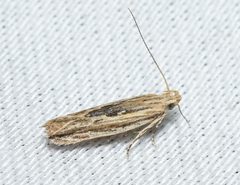
Distinguished from similar Symmetrischema by the combination of: (1) prominent subcostal black line running full length of forewing from base to apex, curving upward; (2) broad, diffused blackish streak on inner margin; (3) variable, often broken discal streak. The specific pattern of three longitudinal dark markings on a light brown ground color is diagnostic. Small size (11–13 mm wingspan) and silken ashy white hindwings further aid identification.
Images
Appearance
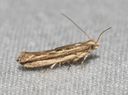
Small with wingspan 11–13 mm. Forewings light brown to brownish ocherous, sparsely speckled with black. A prominent subcostal black longitudinal line runs from base to apex, curving slightly upward and intensifying at the apex. Below this line, two additional blackish striations: a broad, diffused streak on the inner margin and a variable discal streak, often discontinuous or consisting of two to three dashes. Hindwings silken, ashy white, shading to cinereous at the tips.
Habitat
Associated with disturbed and agricultural where plant Solanum nigrum occurs. The host plant grows in fields, gardens, roadsides, and waste areas, suggesting the occupies open, sunny environments with herbaceous vegetation.
Distribution
Native to North America: recorded from Alabama, Arkansas, California, Florida, Illinois, Louisiana, Maine, Maryland, Mississippi, Missouri, New Jersey, Oklahoma, South Carolina, Tennessee, and Texas. Introduced to New Zealand (accidental establishment).
Diet
Larvae feed on berries of Solanum nigrum (black nightshade). feeding habits not documented.
Host Associations
- Solanum nigrum - larval food plantlarvae feed specifically on berries
Human Relevance
Potential minor pest in agricultural settings where Solanum nigrum occurs as a weed; no significant economic impact documented. Accidental introduction to New Zealand demonstrates human-mediated capability.
Similar Taxa
- Symmetrischema tangoliasSimilar size and general appearance, but S. striatella distinguished by specific pattern of three blackish longitudinal striations on forewing, particularly the prominent subcostal line and broad inner marginal streak
- Other Symmetrischema speciesMany lack the distinctive triple-striation pattern; precise forewing marking configuration is key to separating S. striatella from closely related in the
More Details
Taxonomic History
Originally described as Eucatoptus striatella by Mary Murtfeldt in 1900; later transferred to Symmetrischema.
Invasion Biology
Accidental introduction to New Zealand represents a notable range expansion outside native North American distribution, likely via human transport of plant material or contaminated goods.