
Neopalpa donaldtrumpi
Nazari, 2017
Donald Trump Moth
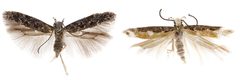
Neopalpa donaldtrumpi is a micro- described in 2017 from specimens collected in the Algodones Dunes of Southern California and Northern Baja California, Mexico. It is the second species in the Neopalpa, distinguished by yellowish-white that inspired its eponymous name. The species has a wingspan of less than one centimeter and was discovered through re-examination of museum specimens. Its naming was intended to draw public attention to conservation for undescribed species in urbanized regions.

Pronunciation
How to pronounce Neopalpa donaldtrumpi: //niː.əˈpælpə ˌdɒnəldˈtrʌmpi//
These audio files are automatically generated. While they are not always 100% accurate, they are a good starting point.
Identification
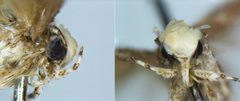
Distinguished from congeneric N. neonata by yellowish-white (N. neonata has brownish head scales). Male genitalia structures smaller than in N. neonata; female genitalia possess very few small setae compared to N. neonata. Forewing length 3–4.6 mm versus 4.5–6.5 mm in N. neonata. Known only from Algodones Dunes region, while N. neonata occurs more broadly throughout California and Baja California.
Images
Appearance
A minute with wingspan of 3–4.6 mm. Forewings orange-yellow with dark brown patches on fringe and portions. Hindwings pale buff with dark fringes. Sexes similar in wing coloration. covered with distinctive yellowish-white . approximately two-thirds of wingspan length.
Habitat
Algodones Dunes (Imperial Sand Dunes) region; sandy desert washes and dunes. described as fragile and threatened by urbanization.
Distribution
Restricted range in Northern Baja California, Mexico and Southern California, USA (Riverside and Imperial counties). Specimens collected only from Algodones Dunes area.
Seasonality
Appears to be evenly distributed through the year based on collection records; specific period not documented.
Behavior
Belongs to twirler moths ( Gelechiidae), known for characteristic spinning on leaves. Specific behaviors of this not documented.
Human Relevance
Named after Donald Trump in 2017 to draw public attention to conservation of fragile containing undescribed species. specimen permanently housed at Bohart Museum of Entomology, UC Davis. Subject of media attention and misinformation (fake images circulated online, debunked by Snopes in 2024).
Similar Taxa
- Neopalpa neonataOnly other in ; distinguished by brownish , larger size (4.5–6.5 mm forewing length), broader distribution, and differences in genitalia structure
Misconceptions
Fake images circulated online in 2024 depicting a with elaborate blond tufts and multicolored wings (pink, black, orange, metallic green); these images were actually modified butterflies, not N. donaldtrumpi. The real moth has simple yellowish-white and orange-yellow wings with brown patches.
More Details
Discovery
Discovered by Vazrick Nazari in 2017 from specimens collected by Thomas Zavortink and colleagues at Bohart Museum of Entomology during six-year survey (2009–2015) of Algodones Dunes for U.S. Bureau of Land Management. Survey collected nearly 2,000 insect from ~200 square miles; 6% were new to science. collected in in wash on east side of dunes.
Etymology
Named for yellowish-white resembling then President-elect Donald Trump's hairstyle. Nazari explicitly stated naming intent was to bring wider public attention to need for continued protection of fragile U.S. containing many undescribed species.
Type Specimen
deposited at Bohart Museum of Entomology, UC Davis; retained by describer in Canada.
Sources and further reading
- BugGuide
- Wikipedia
- GBIF taxonomy match
- iNaturalist taxon
- NCBI Taxonomy
- Catalogue of Life
- A Moth Like No Other: Neopalpa donaldtrumpi | Bug Squad
- A Moth Named for Trump, Snopes, and the Bohart Museum of Entomology | Bug Squad
- Celebrating National Moth Night at the Bohart Museum of Entomology | Bug Squad
- A Gathering of Lepidopterists: Who's Who of the Butterfly, Moth Experts | Bug Squad
- Eight weird and wonderful species to celebrate World Animal Day
- environment | Blog - Part 4