
Gnorimoschema saphirinella
(Chambers, 1875)
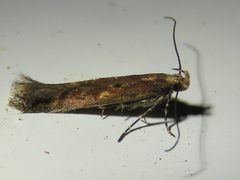
Gnorimoschema saphirinella is a small gelechiid described by V.T. Chambers in 1875. It is widely distributed across North America, with records from at least 14 U.S. states spanning the southern, central, and western regions. The exhibits in forewing length. are active for much of the year, and larvae are specialized leaf miners on Ambrosia species.
Pronunciation
How to pronounce Gnorimoschema saphirinella: /ɡnɔːrɪmoʊˈskɛmə sæˌfaɪrɪˈnɛlə/
These audio files are automatically generated. While they are not always 100% accurate, they are a good starting point.
Identification
Forewing length measurements provide the primary documented means of distinguishing sexes: males 4.5–6 mm, females 4.2–5.9 mm. Within the Gnorimoschema, identification to level requires examination of genitalia or larval association, as many species are morphologically similar. The larval mining habit on Ambrosia species may aid in field recognition where host plants are present.
Images
Appearance
Small with forewings 4.5–6 mm in males and 4.2–5.9 mm in females. As a member of Gelechiidae, it likely has narrow, forewings with relatively simple patterning typical of the , though specific coloration details are not documented in the provided sources.
Habitat
Associated with supporting Ambrosia plants, which include disturbed areas, roadsides, and open fields. The ' broad geographic range suggests adaptability to varied environments across southern, central, and western North America.
Distribution
Recorded from Alabama, Arizona, California, Colorado, Florida, Georgia, Illinois, Kansas, Mississippi, New Mexico, North Dakota, Oklahoma, Tennessee, and Texas. Distribution records also indicate presence in Mexico.
Seasonality
are on wing from February to October, indicating a prolonged period spanning most of the year in warmer regions.
Diet
Larvae feed on Ambrosia chamissonis, Ambrosia confertifolia, and Ambrosia psilostachya (ragweeds). They mine the leaves of these plants.
Host Associations
- Ambrosia chamissonis - larval
- Ambrosia confertifolia - larval
- Ambrosia psilostachya - larval
Life Cycle
Larvae are leaf miners, feeding internally within Ambrosia leaves. Specific details regarding site, number of , or stage are not documented.
Behavior
, as are attracted to light. Larvae exhibit endophagous feeding , mining between leaf surfaces.
Ecological Role
As a , larvae create internal feeding tunnels in Ambrosia leaves. The ecological impacts of this herbivory on plant and interactions have not been quantified. No gall-forming is documented for this .
Human Relevance
No direct economic or medical significance is documented. The is not known to be a pest of cultivated plants.
Similar Taxa
- Gnorimoschema gallaesolidaginisAlso in Gnorimoschema, but distinguished by causing elongate stem galls on goldenrod (Solidago) rather than leaf mines on Ambrosia; and larval differ substantially.
- Other Gnorimoschema speciesMany are morphologically similar and require dissection or rearing from known for confident identification; G. saphirinella is specifically associated with Ambrosia leaf mining.
More Details
Taxonomic history
Originally described as Gelechia saphirinella by V.T. Chambers in 1875, later transferred to Gnorimoschema. The epithet 'saphirinella' likely references a sapphire-like coloration, though this is not explicitly documented.
Research significance
The has been collected extensively enough to document sexual size dimorphism in wing length, but detailed studies of its remain limited compared to some .
Sources and further reading
- BugGuide
- Wikipedia
- GBIF taxonomy match
- iNaturalist taxon
- NCBI Taxonomy
- Catalogue of Life
- Blacklighting at the Bohart: They Saw the Light | Bug Squad
- Meet 'The Moth Man' at Bohart Museum's Moth Night | Bug Squad
- Gnorimoschema gallaesolidaginis Archives - Entomology Today
- How Some Insects Turn Plants Into Pollution Detectors
- goldenrod gall - Entomology Today