
Frumenta
Busck, 1939
Species Guides
3- Frumenta davidi
- Frumenta nephelomicta
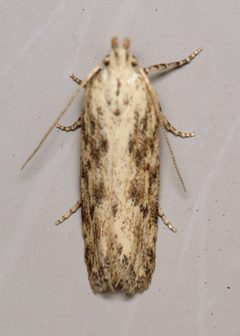
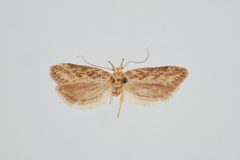
- Frumenta nundinella(Mottled Twirler)
Frumenta is a of gelechiid moths established by Busck in 1939. The genus contains three described , with F. nundinella being the most studied due to its specialized association with Solanum carolinense (horsenettle). Larvae of F. nundinella exhibit distinct biphasic feeding , attacking vegetative shoots in early summer and fruits in late summer. The genus is notable for inducing parthenocarpy in its plant, causing the production of seedless fruits.
Pronunciation
How to pronounce Frumenta: /fɹuːˈmɛntə/
These audio files are automatically generated. While they are not always 100% accurate, they are a good starting point.
Images
Habitat
Associated with Solanum carolinense (horsenettle) in disturbed areas; infested plants often occur in small isolated patches
Distribution
North America; recorded from southwest Virginia and Canada
Seasonality
Two per year in Virginia: first generation active late May to early August, second generation adults active late August to late September
Diet
Larvae of F. nundinella feed on Solanum carolinense; first larvae consume terminal shoot growth, second generation larvae feed within berries and destroy seeds
Host Associations
- Solanum carolinense L. - only known for F. nundinella; also recorded for F. solanophaga based on epithet
Life Cycle
F. nundinella has two per year with complete -to- cycle of approximately 50 days per generation. adults emerge and oviposit on new shoot tips in late May. First generation: larvae feed mid-June, pupate mid-June to July, adults emerge late June to early August. Second generation: larvae feed in fruits, pupate inside berries, adults emerge late August to late September
Behavior
First larvae construct individual tight hollow shelters from folded leaves around terminal shoots. Second generation larvae pupate inside berries. Mature larvae create exit holes in fruit walls before , leaving only a thin covering the opening. Attacked berries become externally recognizable only when larvae reach fourth instar
Ecological Role
Herbivore that damages plants through both shoot and fruit feeding; induces parthenocarpy in Solanum carolinense, causing production of seedless fruits
Similar Taxa
- Tuta absolutaAnother gelechiid with Solanum association and larval mining ; Frumenta distinguished by fruit- and parthenocarpy induction
More Details
Host Manipulation
F. nundinella larvae induce parthenocarpy in Solanum carolinense, causing the plant to produce seedless fruits without . This manipulation may benefit the larva by maintaining fruit tissue as a food source
Detection Difficulty
Berry are difficult to detect early; characteristic appearance only develops at fourth instar, by which time larvae have already consumed most seeds
Sources and further reading
- BugGuide
- Wikipedia
- GBIF taxonomy match
- iNaturalist taxon
- NCBI Taxonomy
- Catalogue of Life
- OCCURRENCE OF FRUMENTA NUNDINELLA (LEPIDOPTERA: GELECHIIDAE) IN CANADA
- Frumenta nundinella (Lepidoptera: Gelechiidae): Life History and Induction of Host Parthenocarpy
- BIOLOGY OF FRUMENTA NUNDINELLA (LEPIDOPTERA: GELECHIIDAE) ON HORSENETTLE IN VIRGINIA