
Frumenta nundinella
(Zeller, 1873)
Mottled Twirler
Frumenta nundinella is a gelechiid with two per year in temperate North America. It is an obligate on Solanum carolinense (horsenettle), with larvae inducing characteristic leaf shelters in the first generation and feeding within fruits in the second generation. The is notable for inducing parthenocarpic fruit development in its , creating galls within which larvae complete development. overwinter and emerge to oviposit on new shoot tips in late spring.
Pronunciation
How to pronounce Frumenta nundinella: /fruːˈmɛn.tə ˌnʊn.dɪˈnɛl.lə/
These audio files are automatically generated. While they are not always 100% accurate, they are a good starting point.
Identification
Recognizable by the combination of pale buff forewings with indefinite dark markings and the distinctive larval . First- larvae create tight, round, hollow leaf shelters on terminal shoots of Solanum carolinense. Second-generation larvae develop within fruits, with infested berries showing characteristic appearance only from the fourth instar onward. Mature larvae create exit holes sealed with thin before . Similar gelechiid lack this specific association and shelter-making .
Images
Appearance
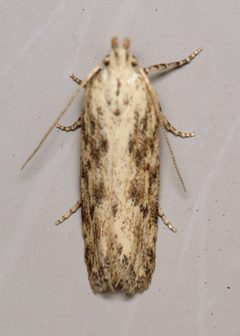
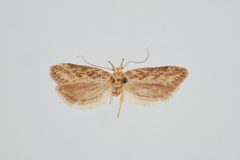
Wingspan approximately 24 mm. Forewings pale buff or cream with ochreous shadings, sparsely dusted with blackish , and marked with numerous indefinite blackish or dark steel grey markings. Hindwings silky cinereous with slight iridescence.
Habitat
Associated with Solanum carolinense (horsenettle) plants, often in small, isolated patches. plant typically occurs in disturbed , agricultural edges, and open fields in eastern North America.
Distribution
North America: eastern United States (Alabama, Arkansas, Illinois, Indiana, Kentucky, Louisiana, Michigan, Mississippi, North Carolina, Ohio, Oklahoma, South Carolina, Tennessee, Texas) and Canada (first record reported, specific locality not detailed in available sources).
Seasonality
Two per year in southwestern Virginia. First generation: emerge late June to early August. Second generation: adults emerge late August to late September. adults oviposit in late May.
Diet
Larvae feed exclusively on Solanum carolinense. First : terminal shoots, incipient flower buds, and infolded leaf edges. Second generation: developing fruits and seeds; a single larva can destroy all seeds within a berry. diet not documented.
Host Associations
- Solanum carolinense - obligate Only known plant; larvae feed on shoots (first ) and fruits (second generation)
Life Cycle
Two per year; complete -to- cycle approximately 50 days per generation. adults lay eggs on tips of emerging shoots in late May. First generation: larvae feed on terminal growth in mid-June, each enclosed in a leaf shelter; mid-June to July; adult late June to early August. Second generation: larvae feed on fruits, pupate inside berries; adult emergence late August to late September.
Behavior
First- larvae construct individual, tight, hollow, spherical shelters from folded terminal leaves. Second-generation larvae pupate within fruits after creating exit holes sealed with thin . Larval feeding induces parthenocarpic fruit development, effectively galling the host tissue.
Ecological Role
herbivore and seed of Solanum carolinense. Low natural rates in studied . Potential agent for horsenettle due to destructive seed-feeding capacity of second- larvae.
Human Relevance
Studied as a potential agent for Solanum carolinense, a weedy plant with agricultural and veterinary significance. No other documented economic or cultural importance.
Similar Taxa
- Other Gelechiidae on SolanumLack the distinctive two- feeding strategy with leaf shelters in first generation and fruit-galling in second generation; specificity differs
- Tuta absolutaAlso in Gelechiidae but feeds on tomato and other Solanaceae; does not induce parthenocarpic galls or construct leaf shelters
More Details
Gall induction mechanism
Larval feeding induces parthenocarpic fruit development in Solanum carolinense, creating galls that provide protected development sites. This represents a derived interaction with the plant beyond simple herbivory.
Detection difficulty
Second- fruit are not easily detected until larvae reach the fourth instar, at which point berries develop a characteristic appearance. This cryptic early stage may contribute to low observed infestation rates in field surveys.
Sources and further reading
- BugGuide
- Wikipedia
- GBIF taxonomy match
- iNaturalist taxon
- NCBI Taxonomy
- Catalogue of Life
- OCCURRENCE OF FRUMENTA NUNDINELLA (LEPIDOPTERA: GELECHIIDAE) IN CANADA
- Frumenta nundinella (Lepidoptera: Gelechiidae): Life History and Induction of Host Parthenocarpy
- BIOLOGY OF FRUMENTA NUNDINELLA (LEPIDOPTERA: GELECHIIDAE) ON HORSENETTLE IN VIRGINIA