
Helcystogramma
Zeller, 1877
Species Guides
6- Helcystogramma badia
- Helcystogramma chambersella(Chambers' Twirler)
- Helcystogramma fernaldella(Fernald's Helcystogramma Moth)
- Helcystogramma hystricella(Lanceolate Helcystogramma Moth)
- Helcystogramma melanocarpa
- Helcystogramma melantherella
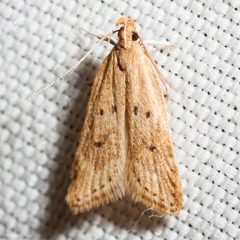
Helcystogramma is a of small in the Gelechiidae, established by Philipp Christoph Zeller in 1877. The genus contains approximately 93+ described distributed almost worldwide, with highest diversity in Asia. Several species are economically significant agricultural pests, notably of malvaceous and convolvulaceous crops. Larvae are characterized by leaf-folding , feeding within folded or rolled leaves.
Pronunciation
How to pronounce Helcystogramma: /hɛlˌsɪstəˈɡræmə/
These audio files are automatically generated. While they are not always 100% accurate, they are a good starting point.
Identification
within Helcystogramma are small gelechiid moths typically requiring dissection of genitalia for definitive identification. The can be distinguished from related dichomeridine genera by genitalic characters, particularly the structure of male valvae and female signum. Larval identification is complicated; in at least one species (H. hibisci), fourth-instar male larvae possess dark-colored visible through the of abdominal segments, a sexually dimorphic character useful for distinguishing sexes before .
Images
Habitat
Agricultural fields and areas supporting plants in Malvaceae and Convolvulaceae. Specimens have been collected from rolled or folded leaves of cultivated crops including sweet potato (Ipomoea batatas) and musk mallow (Abelmoschus moschatus).
Distribution
Almost worldwide distribution. Approximately half of described occur in Asia. Documented from Europe, Russia, the Caucasus, Central Asia, East Asia, northern India, and North America (including Vermont, USA, and Scandinavian countries).
Diet
Larvae feed on mesophyll tissue of plants, consuming internal leaf material while leaving the transparent intact. Documented host plants include in Malvaceae (Abelmoschus moschatus) and Convolvulaceae (Ipomoea batatas).
Host Associations
- Abelmoschus moschatus - pestmusk mallow; oligophagous pest of malvaceous plants
- Ipomoea batatas - pestsweet potato; major agricultural pest in China with damage rates of 60–85% in some regions
Life Cycle
Complete with , larva, pupa, and stages. In H. hibisci: egg 4.70 ± 0.64 days; larval period 13.66 ± 0.86 days; pupal period 6.46 ± 0.61 days (male) and 7.60 ± 0.71 days (female). Adult longevity: 4.93 ± 1.38 days (male), 8.06 ± 1.56 days (female). Average : 61.20 ± 11.68 eggs per female. Five larval instars with capsule widths increasing from 0.26 mm to 1.13 mm.
Behavior
Larvae are leaf folders: early instars scrape tender leaf surfaces, while later instars web leaves by folding them longitudinally and feed within the protected enclosure. This feeding severely impairs plant photosynthetic capacity, causing leaf wither and potentially plant death. occurs within the folded leaf shelters.
Ecological Role
Significant agricultural pest causing economic damage to cultivated crops. Larval herbivory reduces photosynthetic capacity and can lead to plant mortality. can result in crop damage rates exceeding 60% in affected regions.
Human Relevance
Economic pest of medicinal and aromatic plants (musk mallow in India) and staple crops (sweet potato in China). Management requires proper identification through integrative approaches combining , genitalia dissection, and molecular confirmation. First description of H. hibisci from India includes molecular verification (GenBank ON545806) to support accurate pest identification.
Similar Taxa
- Other Dichomeridinae generaRequire genitalic dissection for separation; Helcystogramma distinguished by specific valval and signum structures
- Other leaf-folding LepidopteraBehaviorally convergent; Helcystogramma larvae distinguished by specificity and internal feeding pattern leaving transparent
More Details
Taxonomic History
Formerly included Helcystogramma ceriochrantum (Meyrick, 1939) and Helcystogramma obseratella (Zeller, 1877), now excluded from the .
Genomic Resources
- assembly available for H. triannulella: 387.28 Mb, 30 chromosomes, 96.2% BUSCO completeness, 14,211 protein-coding genes (2025).
Sources and further reading
- BugGuide
- Wikipedia
- GBIF taxonomy match
- iNaturalist taxon
- NCBI Taxonomy
- Catalogue of Life
- Biology and integrative taxonomy of leaf folder, Helcystogramma hibisci (Stainton, 1859): a pest of musk mallow, Abelmoschus moschatus (L.) Medik.
- Chromosome-scale genome assembly of Helcystogramma triannulella (Lepidoptera: Gelechiidae).