
Dichomeris vacciniella
Busck, 1915
Dichomeris vacciniella is a small gelechiid described by August Busck in 1915. It occurs across eastern North America from Canada to the southern United States. The is associated with Vaccinium plants, with larvae feeding on cranberry and related species. are active throughout much of the year, with records spanning February through October.
Pronunciation
How to pronounce Dichomeris vacciniella: /daɪˈkoʊmərɪs vækˈsɪnɪɛlə/
These audio files are automatically generated. While they are not always 100% accurate, they are a good starting point.
Identification
Distinguished from similar Dichomeris by the combination of three black dots edged with white on the forewing, the purplish black suffusion in the area, and the specific arrangement of these markings relative to the wing and fold. The dark brown ground color with sparse black dusting separates it from more uniformly colored or more heavily patterned .
Images
Appearance
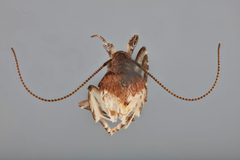
Small with wingspan of 15–17 mm. Forewings dark brown, sparsely and irregularly dusted with black scales. Three small, round, black dots edged with white present: one on middle of , one obliquely below and before it on fold, and one at end of cell. part of forewing strongly suffused with purplish black scales; extreme apical and terminal edge black. Hindwings light fuscous, suffused with black on outer costal part.
Habitat
Associated with supporting Vaccinium , including bogs, wetlands, and acidic woodlands where cranberries and blueberries occur.
Distribution
Eastern North America: recorded from Nova Scotia, southern Quebec and southern Ontario south to Florida, west to Michigan, Missouri and Arkansas.
Seasonality
on wing from February to October; multi-brooded or extended period with activity across most of the year in warmer parts of range.
Diet
Larvae feed on Vaccinium , specifically recorded from Vaccinium macrocarpon (large cranberry) and Vaccinium pallidum (blueberry huckleberry). diet not documented.
Host Associations
- Vaccinium macrocarpon - larval food plantlarge cranberry
- Vaccinium pallidum - larval food plantblueberry huckleberry
Life Cycle
Complete with larval stage feeding on Vaccinium foliage or fruit. Specific details of , pupal stages, and number of per year not documented.
Ecological Role
Herbivore on Vaccinium ; likely contributes to natural pruning and nutrient cycling in bog and wetland . Potential pest of cultivated cranberries.
Human Relevance
Potential economic significance as a pest of commercial cranberry (Vaccinium macrocarpon) , though specific damage levels and management requirements not well documented.
Similar Taxa
- Other Dichomeris speciesMany share similar size and general gelechiid ; distinguished by specific forewing pattern of three white-edged black dots and purplish suffusion.
More Details
Taxonomic history
Described by August Busck in 1915 based on North American material. The epithet 'vacciniella' reflects its association with Vaccinium plants.