
Dichomeris simpliciella
(Busck, 1904)
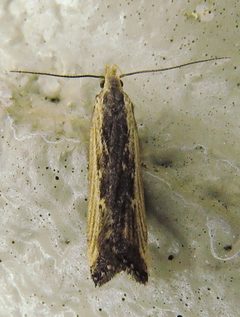
Dichomeris simpliciella is a small gelechiid described by August Busck in 1904. It is distributed across western and south-central North America, from southern Alberta through the western United States to Texas and northern Mexico. The exhibits distinctive bicolored forewings with a sharp longitudinal division between light ochreous and dark fuscous areas. are active during two periods: spring (April–June) and late summer through autumn (August–November).
Pronunciation
How to pronounce Dichomeris simpliciella: //daɪˈkɒmərɪs sɪmplɪˈsjɛlə//
These audio files are automatically generated. While they are not always 100% accurate, they are a good starting point.
Identification
The sharply defined, straight longitudinal line dividing the forewing into contrasting light ochreous and dark fuscous halves is diagnostic. The small size (wingspan ~18 mm) and the presence of a pale round discal dot further distinguish this . Similar Dichomeris species typically show more irregular wing patterns or different color proportions.
Images
Appearance
Small with wingspan approximately 18 mm. Forewings sharply divided longitudinally into two nearly equal parts: costal (leading edge) portion light ochreous, portion dark fuscous. Dividing line runs nearly straight from wing base to apex. Fuscous dorsal area slightly overlaid with ochreous in third, except along termen where dark color intensifies before the cilia. Small, very light ochreous round dot present at end of .
Distribution
North America: southern Alberta, Canada; western and south-central United States including eastern Washington, south-eastern Nevada, Arizona, and Texas; northern Mexico.
Seasonality
active April–June and August–November. Bimodal pattern suggests two per year.
Similar Taxa
- Dichomeris spp.Other in lack the sharply straight longitudinal wing division; most show more mottled or irregular patterning.