
Dichomeris leuconotella
(Busck, 1904)
Two-spotted Dichomeris Moth
Dichomeris leuconotella is a gelechiid described by August Busck in 1904. Its larvae are specialized leaf-folders on goldenrods (Solidago spp.), constructing silk-bound shelters for feeding and protection. are active from June to September across much of North America.
Pronunciation
How to pronounce Dichomeris leuconotella: /ˈdaɪkoʊˌmɛrɪs ˌljuːkəˈnɒtɛlə/
These audio files are automatically generated. While they are not always 100% accurate, they are a good starting point.
Identification
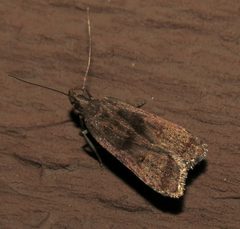
Distinguished from similar Dichomeris by the prominent canary yellow spot at the end of the forewing , contrasting with the dark purplish brown ground color. The triangular light-brown costal spot is faint and less diagnostic. The combination of dark shining forewings with a bright yellow discal spot is distinctive within the .
Images
Appearance
have a wingspan of approximately 17 mm. Forewings are dark purplish brown and shining, with a conspicuous canary yellow, somewhat elongated spot at the end of the and a barely visible triangular light-brown costal spot at the third. Hindwings are dark fuscous.
Habitat
Open fields containing plants. Larval microhabitat consists of folded leaves on goldenrod plants, with specific host and conditions affecting larval performance.
Distribution
North America: recorded from Nova Scotia to Maryland, southern Canada (including Alberta), Washington, Colorado, Iowa, and Indiana.
Seasonality
on wing from June to September. Larval activity coincides with plant growing season.
Diet
Larvae feed on leaves of Solidago uliginosa, Helianthus grosseserratus, and Aster . Feeding occurs within constructed leaf folds.
Host Associations
- Solidago uliginosa - larval plantprimary in some studies
- Helianthus grosseserratus - larval plant
- Aster species - larval plant
- Solidago spp. - larval plantgeneral ; specific affect larval growth and survival
Life Cycle
Early instar larvae construct leaf folds or silk webs on plants for shelter and feeding. Larvae remain within these , with refuge quality affecting growth rates. Disturbed larvae that rebuild shelters on younger leaves show higher growth rates than those remaining on senescing leaves. likely occurs within shelters, though specific details are not documented.
Behavior
Caterpillars exhibit leaf-folding , using silk to bind leaves into shelters that provide favorable microclimate and protection. Larvae a trade-off between stability and optimal feeding: remaining in established shelters risks exposure to leaf , while rebuilding shelters risks dislodgment or wandering-related mortality. In the absence of , forced refuge changes increase disappearance rates due to falling or wandering from plants.
Ecological Role
Herbivore on goldenrods and related asters; leaf-folding damage may influence plant through localized tissue removal and photosynthetic reduction.
Similar Taxa
- Other Dichomeris speciesSimilar size and wing shape; distinguished by the conspicuous canary yellow forewing spot and dark purplish brown ground color of D. leuconotella
More Details
Leaf-folding energetics
Contrary to expectation, the energetic cost of silk production for construction appears negligible or easily compensated in this . Growth rate reductions from refuge rebuilding are attributable to leaf age selection rather than metabolic costs of silk production.
Sources and further reading
- BugGuide
- Wikipedia
- GBIF taxonomy match
- iNaturalist taxon
- NCBI Taxonomy
- Catalogue of Life
- Host plant and habitat effects on behavior, survival, and growth of early instar Dichomeris leuconotella (Lepidoptera: Gelechiidae), leaf-folders on goldenrods
- Adaptive trade‐offs of leaf folding in Dichomeris caterpillars on goldenrods