
Dichomeris juncidella
(Clemens, 1860)
Orange-dotted Dichomeris Moth
Dichomeris juncidella is a small gelechiid with distinctive orange spotting on dark brown forewings. It occurs across eastern and central North America, with active from spring through fall. The was described by James Brackenridge Clemens in 1860.
Pronunciation
How to pronounce Dichomeris juncidella: //daɪˈkɑːməˌrɪs ˌdʒʌnsɪˈdɛlə//
These audio files are automatically generated. While they are not always 100% accurate, they are a good starting point.
Identification
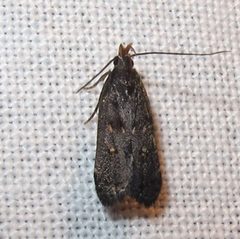
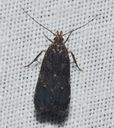
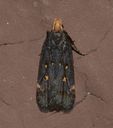
Distinguished from similar Dichomeris by the specific arrangement of four ochreous-orange spots on dark forewings, including the subcostal and fold positions. The small costal spot near the apex and dull yellowish-brown hindwings further aid recognition. Combination of dark ground color with orange markings is distinctive within its range.
Images
Appearance
Small with wingspan approximately 13 mm. Forewings dark brown to blackish-brown with four ochreous-orange spots: one on the disk, one on the subcostal nervure near the base, one beneath it in the fold, and one at the end of the disk. Small ochreous-orange spot present on near wing tip. Hindwings dull yellowish-brown.
Distribution
Eastern and central North America: Nova Scotia, southern Quebec, and southern Ontario south to Florida, west to Texas and Nebraska. Additional records from Vermont.
Seasonality
active March through October; multivoltine with extended period.
Diet
Larvae feed on Ambrosia artemisiifolia (common ragweed), Artemisia trifida, Solidago (goldenrod), Aster, Helianthus tuberosus (Jerusalem artichoke), and Aralia spinosa (devil's walkingstick).
Host Associations
- Ambrosia artemisiifolia - larval
- Artemisia trifida - larval
- Solidago - larval
- Aster - larval
- Helianthus tuberosus - larval
- Aralia spinosa - larval
Life Cycle
Complete with larval stage feeding on recorded plants. period spans March to October, suggesting multiple annually.
Ecological Role
Larval herbivore on multiple plant across Asteraceae and Araliaceae. Role in pollination as unknown.
Human Relevance
Larvae feed on common ragweed (Ambrosia artemisiifolia), a significant allergen-producing plant, suggesting potential incidental value.
Similar Taxa
- Other Dichomeris speciesMany share dark forewing ground color but differ in spot number, position, or color; precise spot arrangement of D. juncidella is diagnostic.
More Details
Original description
First described as Trichotaphe juncidella by James Brackenridge Clemens in 1860, later transferred to Dichomeris.