
Dichomeris copa
Hodges, 1986
Copa Dichomeris Moth
A small gelechiid described by Ronald W. Hodges in 1986. The name derives from Latin 'copa' meaning 'dancing girl.' are active from June through September and have been recorded across the eastern and central United States and southern Canada. The larvae feed on goldenrod species (Solidago).
Pronunciation
How to pronounce Dichomeris copa: //ˈdaɪˌkoʊ.mɪ.rɪs ˈkoʊ.pə//
These audio files are automatically generated. While they are not always 100% accurate, they are a good starting point.
Identification
The small size (15 mm wingspan) and period from June to September in combination with its documented association with Solidago plants may aid in field identification. Specific diagnostic characters distinguishing it from other Dichomeris are not documented in available sources. Dissection and examination of genitalia would likely be required for definitive identification.
Images
Appearance
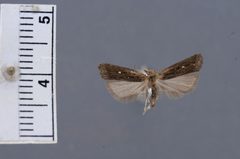
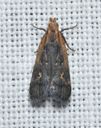
have a wingspan of approximately 15 mm. As a member of the Gelechiidae, it possesses the typical narrow, forewings and more triangular hindwings characteristic of twirler moths. Detailed coloration and pattern descriptions are not available in published sources.
Habitat
Associated with supporting its larval plants, Solidago (goldenrods). These include old fields, prairies, open woodlands, and disturbed areas where goldenrods occur. The has been collected in both dry and mesic environments across its range.
Distribution
North America: recorded from Wyoming east to southern Ontario and Vermont, south to southern Illinois and Maryland. Distribution records from GBIF include Canada and the United States, with specific state/province records for Vermont.
Seasonality
are on wing from June to September. This corresponds with the flowering period of its Solidago plants.
Diet
Larvae feed on Solidago (goldenrods). feeding habits are not documented.
Host Associations
- Solidago - larval -level association; specific Solidago not distinguished in sources
Life Cycle
Complete with , larval, pupal, and stages. Larvae develop on Solidago plants. Specific details of site, number of per year, and stage are not documented.
Behavior
activity suggested by attraction to light, though this is not explicitly documented for this . Larval feeding occurs on foliage of plants.
Ecological Role
As a herbivore, larvae contribute to nutrient cycling through consumption of Solidago foliage. The functions as a herbivore tied to goldenrod-dominated plant . Its role in as prey for is likely but not documented.
Human Relevance
No documented economic importance. The has potential as a biological indicator of goldenrod quality. It is not known to be a pest of ornamental or agricultural Solidago plantings.
Similar Taxa
- Other Dichomeris speciesMany Dichomeris are small, brownish gelechiid moths with similar ; reliable identification requires genitalia dissection and comparison with
More Details
Etymology
The name 'copa' is derived from Latin meaning 'dancing girl,' applied by describer Ronald W. Hodges in 1986.
Taxonomic history
Described in 1986 by Ronald W. Hodges, a in North American Lepidoptera .
Sources and further reading
- BugGuide
- Wikipedia
- GBIF taxonomy match
- iNaturalist taxon
- NCBI Taxonomy
- Catalogue of Life
- Why Insects Make Great Ambassadors for Science Education
- Hughes Mountain redux | Beetles In The Bush
- Uncategorized | Blog - Part 41
- Plantae | Beetles In The Bush | Page 7
- Pensoft blog - Part 147
- Megalopygidae | Beetles In The Bush