
Aristotelia ivae
Busck, 1900
Aristotelia ivae is a small in the Gelechiidae, described by August Busck in 1900. It is native to the southeastern United States, with confirmed records from Florida and Georgia. The was introduced to Australia in 1969 as a agent for the weed Baccharis halimifolia. Its larvae feed specifically on Iva frutescens in its native range.
Pronunciation
How to pronounce Aristotelia ivae: //ˌærɪstoʊˈtiːliə ˈaɪvi//
These audio files are automatically generated. While they are not always 100% accurate, they are a good starting point.
Identification
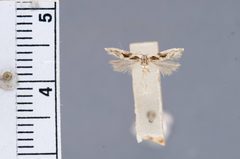
Distinguished from other Aristotelia by the specific pattern of two dark costal bands reaching the fold, with the first oblique from the base and the second curved from the basal third. The silvery yellow marginal edging on these bands and the black wing tip are additional diagnostic features. The small size (wingspan under 12 mm) and light silvery drab ground color help separate it from larger or more boldly patterned gelechiid moths.
Images
Appearance
have a wingspan of 11.2–11.8 mm. Forewings are light silvery drab, with the outer half dusted with white and black scales. Two dark brown to nearly black bands extend from the to the fold: the first runs obliquely outward from the base of the costa and narrows to a point; the second originates from the basal third, curves outward and upward, and reaches the fold before tapering. Both bands are narrowly margined with silvery yellow. A third indistinct triangular light-brown spot on the costa has wider silvery yellow margins and is followed by a small whitish spot. The wing tip is black. Hindwings are dark gray.
Habitat
Coastal and wetland supporting its larval plant Iva frutescens (marsh elder) in the southeastern United States. In Australia, established in areas where the introduced weed Baccharis halimifolia (groundsel bush) grows.
Distribution
Native to southeastern United States: Florida and Georgia. Introduced to Australia (1969, from Florida) for purposes.
Diet
Larvae feed on Iva frutescens (marsh elder, Asteraceae) in native range. In Australia, larvae feed on introduced Baccharis halimifolia (groundsel bush, Asteraceae).
Host Associations
- Iva frutescens - larval native in North America
- Baccharis halimifolia - larval introduced in Australia; purpose of introduction
Life Cycle
Larvae are approximately 12 mm in length, with a dark purple body marked by eight wavy interrupted longitudinal lines and a yellow . and details are not documented.
Ecological Role
Herbivore specializing on Asteraceae. In Australia, serves as a agent reducing of the weed Baccharis halimifolia.
Human Relevance
Introduced to Australia in 1969 as a agent for Baccharis halimifolia, an weed that displaces native vegetation. The introduction represents one of the earlier documented cases of intentional introduction for weed biocontrol.
Similar Taxa
- Other Aristotelia speciesApproximately 35 named occur in North America north of Mexico; many are undescribed. A. ivae is distinguished by its specific wing pattern and geographic range.
More Details
Biological control history
The 1969 introduction to Australia from Florida represents an early example of using a gelechiid . The was selected for its narrow range on Baccharis halimifolia, a closely related plant to its native host Iva frutescens within Asteraceae.