
Battaristis nigratomella
(Clemens, 1863)
Black-faced Twirler Moth
Battaristis nigratomella is a small in the Gelechiidae, commonly known as the Black-faced Twirler Moth. It is widely distributed across eastern and central North America, with records spanning from Quebec to Texas and Florida to Minnesota. are active from early spring through autumn. The is readily identified by its distinctive wing pattern of white forewings with pale brown markings.
Pronunciation
How to pronounce Battaristis nigratomella: /bætəˈrɪstɪs ˌnɪɡrətoʊˈmɛlə/
These audio files are automatically generated. While they are not always 100% accurate, they are a good starting point.
Identification
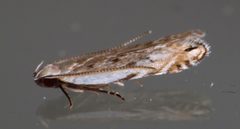
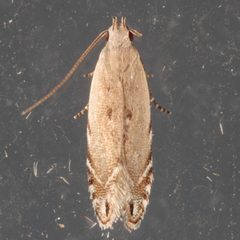
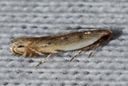
The combination of shining white forewings with pale brown area, oblique white streak margined by dark brown on the , and small black spot beneath the tip distinguishes this from other Battaristis. The hindwings being darker than the forewings is an additional diagnostic feature. The broad geographic range and extended season help separate it from more restricted, seasonal .
Images
Appearance
Small with forewings that are shining white. The portion of the forewing is pale brown and contains an oblique white streak. This streak is margined by dark brown on the . A small black spot is present beneath the wing tip. Hindwings are slightly darker than the forewings.
Distribution
North America: recorded from Alabama, Arizona, Arkansas, Florida, Georgia, Illinois, Indiana, Kentucky, Louisiana, Maine, Massachusetts, Minnesota, Mississippi, North Carolina, Ohio, Oklahoma, Quebec, South Carolina, Tennessee, Texas, Washington, and West Virginia. Distribution records also include Canada and the United States broadly.
Seasonality
on wing from March to October.
More Details
Nomenclature
Originally described as Gelechia nigratomella by Clemens in 1863; later transferred to Battaristis.