
Anacampsis psoraliella
Barnes & Busck, 1920
Anacampsis psoraliella is a small gelechiid described from Iowa in 1920. are nearly indistinguishable from the sympatric A. wikeri by external appearance alone. The is associated with prairie legumes in the Pediomelum, and reliable identification requires examination of genital or knowledge of the larval plant.
Pronunciation
How to pronounce Anacampsis psoraliella: /ænəˈkæmpsɪs ˌsɔræθiˈɛlə/
These audio files are automatically generated. While they are not always 100% accurate, they are a good starting point.
Identification
Externally very similar to Anacampsis wikeri; sight identification of is problematic, especially in the multi-state Midwest area where both occur. Unequivocal requires larval plant data (Pediomelum argophyllum for A. psoraliella versus Amorpha canescens for A. wikeri) or examination of adult genital .
Images
Appearance
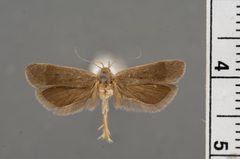
Wingspan 18–21 mm. Forewings nearly unicolorous blackish brown with fourth a shade lighter; the two shades separated by a faint but sharply defined transverse line that is slightly but sharply outwardly curved and pointed at the middle. Four hardly perceptible darker brown spots present: one near the base, one at middle of , one at end of cell, and one at middle of fold. Hindwings dark olivaceous brown.
Habitat
Prairie
Distribution
North America; recorded from Iowa. Sympatric with A. wikeri in the multi-state Midwest region where respective larval hostplants co-occur.
Diet
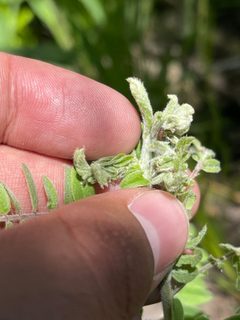
Larvae feed on Pediomelum argophyllum (syn. Psoralea argophylla), a prairie legume.
Host Associations
- Pediomelum argophyllum - larval food plantformerly Psoralea argophylla
Similar Taxa
- Anacampsis wikeri externally very similar; distinguished by larval plant (Amorpha canescens versus Pediomelum argophyllum) and adult genital
More Details
Taxonomic history
Described by William Barnes and August Busck in 1920.
Identification challenges
The close external similarity between A. psoraliella and A. wikeri has led to identification difficulties in museum collections and field surveys. The 2013 description of A. wikeri explicitly addressed this problem, illustrating male and female genitalia of both to enable reliable separation.