
Anacampsis populella
(Clerck, 1759)
poplar sober
A small gelechiid native to Europe, accidentally introduced to North America. are active from May to September with variable whitish forewings marked with black or dark grey. Larvae are leaf-rollers that feed on poplars and willows, constructing silk-bound leaf tubes in which they develop and pupate. The is , with .
Pronunciation
How to pronounce Anacampsis populella: //ˌænəˈkæmpsɪs ˌpɒpjʊˈlɛlə//
These audio files are automatically generated. While they are not always 100% accurate, they are a good starting point.
Identification
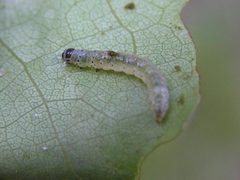
Reliable separation from the similar Anacampsis blattariella requires genitalia dissection; external is insufficient due to high variability in both . Larvae distinguished by greyish-green or yellowish body with round black pinacula, black , and divided black prothoracic plate; anal plate brownish. Leaf-rolling on plants provides a field clue.
Images
Appearance
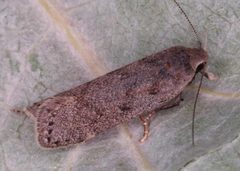
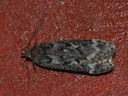
Small with wingspan 14–19 mm. Forewings whitish, variably sprinkled with black or dark grey, often palest toward base of ; costal edge sometimes yellowish-tinged. Variable patterning includes occasional large black patch on two-thirds from base to near tornus; stigmata blackish, often concealed; whitish obtusely angulated fascia at three-quarters, indented above angle, sometimes indistinct; terminal black dots present. Hindwings over 1, rather dark grey. with segments 2–4 often ochreous-yellow. Sexes similar in appearance.
Habitat
Found in stands of poplar and willow, including forest plantations, moorlands with birch, and coastal dunes with creeping willow. occur on tree trunks, in foliage, and come to light.
Distribution
Native to Europe, with records across most of the continent including Sweden (type locality), Germany, Czech Republic, Belgium, and the United Kingdom. Accidentally introduced to North America.
Seasonality
on wing from May to September depending on location; peak activity June to August. Larvae present from mid-April to June. overwinter.
Diet
Larvae feed on leaves of poplars (Populus ) and willows (Salix species). Specific include Populus tremula, Salix caprea, Salix alba, and Salix repens.
Host Associations
- Populus tremula - larval foodplantprimary in some
- Populus sp. - larval foodplantgeneral poplar feeder
- Salix caprea - larval foodplantgoat willow
- Salix alba - larval foodplantwhite willow
- Salix repens - larval foodplantcreeping willow, coastal dunes
Life Cycle
. laid at base of buds in clusters, through winter. Larvae emerge in spring, develop through three instars from April to June. First instar feeds freely on leaf underside; after first , larvae roll leaves with silk into tubes and feed inside. occurs within the rolled leaf in a cocoon. emerge from May to September.
Behavior
Larvae construct leaf rolls by rolling leaves toward the abaxial (lower) surface, securing edges with silk strands. Most rolls contain a single leaf, though 20% incorporate 2–5 leaves. On creeping willow, small leaves require several to be spun around the central shoot. are and attracted to light.
Ecological Role
Herbivore on poplar and willow foliage. Prey for diverse natural enemies including parasitic Hymenoptera (at least 20 recorded, with rates up to 59%), insect , and birds; natural enemies cause 63–88% mortality of larval and pupal .
Human Relevance
Minor pest of Populus tremula in forestry plantations, causing measurable leaf damage. Used as a study organism for leaf-roller and .
Similar Taxa
- Anacampsis blattariellaExternally variable and indistinguishable without genitalia dissection; both share similar size range and color variability.
- Anacampsis temerellaLarvae also roll leaves of Salix repens on coastal dunes; larvae distinguished by morphological details, though both use similar and .
Sources and further reading
- BugGuide
- Wikipedia
- GBIF taxonomy match
- iNaturalist taxon
- NCBI Taxonomy
- Catalogue of Life
- The biology of Anacampsis populella (Clerck) (Lepidoptera, Gelechiidae)
- Zur Morphologie, Biologie und Ökologie von Anacampsis populella (Clerck) (Lep., Gelechiidae) Contributions to the morphology, bionomy and ecology of Anacampsis populella (Clerck) (Lep., Gelechiidae)
- The status and distribution of the nationally rare micro-moth Anacampsis temerella (Lienig and Zeller, 1846) (Lepidoptera: Gelechiidae) in Lancashire in 2021, with observations on other Salix repens L. – feeding Lepidoptera