
Menesta melanella
Murtfeldt, 1890
Black Menesta
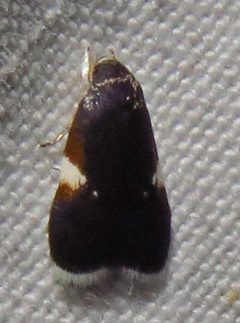
A small North American in the Depressariidae, described by Mary Murtfeldt in 1890. Recognizable by its dark forewings with greenish-violet iridescence and distinctive white markings on both wing pairs. The larvae feed on specific oak .
Pronunciation
How to pronounce Menesta melanella: /mɛˈnɛsta mɛˌlaˈnɛla/
These audio files are automatically generated. While they are not always 100% accurate, they are a good starting point.
Identification
Distinguished from similar Menesta by the combination of greenish-violet forewing iridescence and the specific pattern of white markings: triangular costal patch on forewings and continuous costal streak on hindwings. The small size (10–12 mm wingspan) and dark ground color separate it from larger or paler .
Images
Appearance
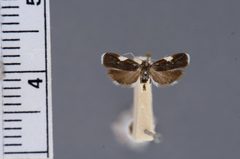
Small with wingspan 10–12 mm. Forewings blackish brown with greenish-violet iridescent reflections; a triangular patch of white present on the approximately midway between base and apex. Hindwings dark with a broad white streak extending along the costa from base to beyond midpoint.
Distribution
Eastern and south-central United States. Recorded from Alabama, Arizona, Florida, Kentucky, Massachusetts, Mississippi, Missouri, New Jersey, North Carolina, Ohio, and South Carolina.
Diet
Larvae feed on Quercus obtusiloba (shrub live oak) and Quercus stellata (post oak). feeding habits unknown.
Host Associations
- Quercus obtusiloba - larval food plant
- Quercus stellata - larval food plant
Similar Taxa
- Other Menesta speciesSimilar size and general appearance, but differ in pattern and extent of white markings on wings; M. melanella specifically shows greenish-violet iridescence and the distinctive hindwing costal streak.
More Details
Taxonomic history
Described by American entomologist Mary Murtfeldt in 1890, an early example of significant contributions by women to North American lepidopterology in the late 19th century.