
Nites maculatella
(Busck, 1908)
Oak Leaftier
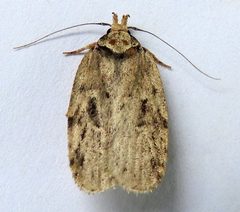
Nites maculatella is a small in the Depressariidae, described by August Busck in 1908. It occurs in eastern North America, with records from the northeastern United States and adjacent Canada. The is associated with American hornbeam (Carpinus caroliniana), on which its larvae feed. have distinctive wing patterning with ochreous-white forewings marked by blackish-fuscous streaks and spots.
Pronunciation
How to pronounce Nites maculatella: //ˈnaɪtiːz ˌmækjuˈleɪtəla//
These audio files are automatically generated. While they are not always 100% accurate, they are a good starting point.
Identification
Distinguished from similar Depressariidae by the combination of: ochreous-white forewing ground color with heavy brown suffusion; the interrupted transverse basal line; paired discal spots with intervening longitudinal streak; and strongly marked nine and ten. The specific pattern of blackish-fuscous spotting along the termen and is distinctive. Similar in the Nites and related genera lack this exact configuration of markings.
Images
Appearance
have a wingspan of 21–23 mm. Forewings are ochreous white, suffused with brown and speckled with blackish fuscous, with ochreous scaling throughout. A transverse blackish-fuscous line runs from the to the inner angle at the wing base, interrupted at the middle. Two poorly defined white discal spots are present—one at the basal third and one at the end of the —separated by a conspicuous longitudinal blackish-fuscous streak. nine and ten are strongly marked with blackish fuscous; other veins less so. A blackish-fuscous spot occurs on the costa at about the middle, with a series of similar spots running from the third of the costa around the termen to the inner margin. Hindwings are whitish fuscous, darker toward the apex.
Habitat
Associated with deciduous forests containing American hornbeam (Carpinus caroliniana), the larval . Specific microhabitat preferences for are not documented.
Distribution
Eastern North America: recorded from Vermont, Maine, Maryland, Pennsylvania, West Virginia, Ohio, Indiana, Kentucky (United States), and Ontario (Canada).
Diet
Larvae feed on Carpinus caroliniana (American hornbeam). feeding habits are not documented.
Host Associations
- Carpinus caroliniana - larval American hornbeam; sole documented plant
Ecological Role
Larval herbivore on American hornbeam; specific ecological impacts are not documented.
Human Relevance
None documented. Not known as an agricultural or forestry pest. "Oak Leaftier" appears to be a misnomer given the documented association with hornbeam rather than oak.
Similar Taxa
- Other Nites speciesSimilar size and general wing pattern; distinguished by specific details of forewing markings, particularly the configuration of discal spots, longitudinal streak, and termen spotting
- Related DepressariinaeOverlapping and ; require examination of genitalia or detailed wing pattern analysis for reliable separation
Misconceptions
The "Oak Leaftier" is misleading, as the documented larval is Carpinus caroliniana (American hornbeam), not oak (Quercus). The origin of this name is unclear but does not reflect the known of the .
More Details
Taxonomic history
Described by August Busck in 1908. The has remained in the Nites without major taxonomic revision.
Observation rarity
Relatively few documented observations (15 records on iNaturalist as of source date), suggesting either genuine rarity or undercollection due to small size and inconspicuous habits.