
Apachea
Clarke, 1941
Species Guides
1Apachea is a of in the Depressariidae, containing the single Apachea barberella. The genus was established by Clarke in 1941, with the species originally described by Busck in 1902. These moths are found in western North America and are characterized by distinctive wing patterning.
Pronunciation
How to pronounce Apachea: //əˈpætʃ.i.ə//
These audio files are automatically generated. While they are not always 100% accurate, they are a good starting point.
Identification
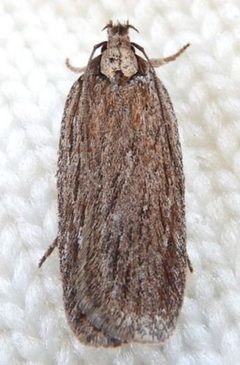
Apachea can be distinguished from other Depressariidae by the combination of: a thin deep black line from the wing base parallel to the , edged with reddish brown; a narrow interrupted white longitudinal line; and a small round white dot at the end of the edged with black and red . The nature of the genus means -level identification within Apachea is not applicable.
Images
Appearance
Apachea barberella has a wingspan of approximately 28 mm. The forewings are light ocherous, dusted with fuscous, reddish and black scales. A thin deep black line runs from the base, parallel with the basal third of the , edged on both sides with reddish brown. A narrow longitudinal white line starts just before this line ends, interrupted by reddish brown . A small black spot occurs at the base near the edge. The fold and are indicated by narrow black lines. At the end of the is a small round white dot, edged by black scales exteriorly and red scales interiorly. The hindwings are light ocherous fuscous, whitish towards the base and darker fuscous along the edges and at the apex.
Habitat
Specific preferences are not documented. Based on the western North American distribution, the likely occurs in montane and arid western environments.
Distribution
Western North America: recorded from Montana, Colorado, New Mexico, Arizona, Utah, and California.
Seasonality
are on wing in winter.
Diet
Larvae feed on Ptelea angustifolia (hop-tree) and Prunus (cherries, plums, and related plants).
Host Associations
- Ptelea angustifolia - larval food planthop-tree
- Prunus - larval food plant includes cherries and plums
Life Cycle
Larval stage feeds on plants; stage occurs in winter. Specific details of and -laying are not documented.
Behavior
are active in winter. Larval feeding on plants has been observed but detailed behavioral descriptions are lacking.
Ecological Role
As a herbivore in larval stages, the contributes to nutrient cycling and serves as potential prey for . Specific ecological studies are not available.
Human Relevance
Minimal direct human relevance. The name barberella honors collector Herbert Spencer Barber, indicating historical scientific collection interest.
Similar Taxa
- Other Depressariidae generaApachea is distinguished by its specific wing pattern elements including the black basal line with reddish brown edges, interrupted white line, and distinctive dot
More Details
Etymology
The epithet barberella honors Herbert Spencer Barber, the collector of the .
Taxonomic history
The was originally described by August Busck in 1902, with the Apachea established later by Clarke in 1941.