
Glyphidocera floridanella
Busck, 1901
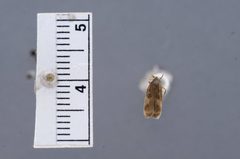
Glyphidocera floridanella is a small in the Autostichidae, first described by August Busck in 1901. It is known from the southeastern United States, specifically Florida and Georgia. The is characterized by its distinctive wing pattern featuring dark patches on a lighter ground color with a purple sheen.
Pronunciation
How to pronounce Glyphidocera floridanella: /ɡlɪfɪdoʊˈsɪrə flɔrɪˈdænɛlə/
These audio files are automatically generated. While they are not always 100% accurate, they are a good starting point.
Identification
Distinguished from other Glyphidocera by the specific pattern of dark patches on the forewings: a large basal patch, a transverse third band, and an apical patch, all with purple sheen. The combination of small size (13.5–15 mm wingspan), light yellowish fuscous ground color with dark overlay, and dark grey hindwings is diagnostic. Similar species in the may lack the distinct three-patch pattern or the pronounced purple sheen.
Images
Appearance
Small with wingspan of 13.5–15 mm. Forewings are light yellowish fuscous, heavily overlaid with dark blackish brown that give a purple sheen. Dark scales form three large, ill-defined patches: one occupying nearly the entire basal third of the wing (most prominent at the basal third), an obscure transverse band across the third, and a third patch covering the apical portion. Lighter ground color visible between patches, sprinkled with scattered single dark scales. Hindwings are uniformly dark grey.
Distribution
Southeastern United States. Recorded from Florida and Georgia.
Similar Taxa
- Other Glyphidocera speciesMay share general size and characteristics, but differ in the specific pattern of dark patches and purple sheen on forewings
More Details
Etymology
Specific epithet 'floridanella' refers to Florida, the type locality where the was first described.