
Eriocraniella variegata
Davis, 1978
Eriocraniella variegata is a small primitive in the Eriocraniidae, described by Donald R. Davis in 1978. It is to the San Gabriel Mountains in southern California. exhibit distinctive iridescent gold and purplish fuscous forewing patterning and are active in May, with a single per year. The larval plant remains unknown.
Pronunciation
How to pronounce Eriocraniella variegata: /ˌɛrioʊkrəˈniːəˌværiˈeɪɡətə/
These audio files are automatically generated. While they are not always 100% accurate, they are a good starting point.
Identification
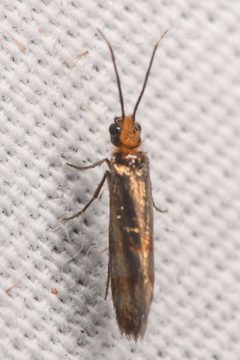
Distinguished from other Eriocraniella by the nearly equal mixture of iridescent gold and purplish fuscous on forewings, with pattern typically forming transverse bands. The relatively broad and specific wing coloration pattern separate it from . Male genitalia with diagnostic structural features described by Davis (1978).
Images
Appearance
Small with wingspan 8.2–9.5 mm in males, 7.8–8.7 mm in females. Forewings irregularly marked with nearly equal iridescent gold and purplish fuscous, typically as transverse bands but sometimes fragmented into large irregular spots. Hindwings slightly darker and less lustrous than forewings, with slight purplish iridescence near apex. relatively broad compared to related .
Habitat
Montane in the San Gabriel Mountains, California. Specific microhabitat preferences not documented, but likely associated with deciduous trees or shrubs given -level .
Distribution
to the San Gabriel Mountains, California, USA. Known only from the type locality area.
Seasonality
active in May. Single per year ().
Life Cycle
Complete with , larval, pupal, and stages. Larval stage presumably leaf-mining in plant foliage, as is typical for Eriocraniidae, but host plant unknown. likely in soil or leaf litter.
Behavior
, flying in May. Specific mating or oviposition not documented.
Ecological Role
Presumably contributes to nutrient cycling as larvae mine leaf tissue. Role in unknown; likely prey for insectivorous birds and arthropods.
Human Relevance
No known economic importance. Of interest to lepidopterists and researchers studying primitive lineages.
Similar Taxa
- Eriocraniella xanthocaraSimilar size and general appearance, but E. variegata distinguished by purplish fuscous and gold pattern versus predominantly yellowish coloration in E. xanthocara
- Dyseriocrania griseocapitellaOverlapping distribution and similar , but D. griseocapitella has grayish and different wing pattern lacking strong iridescent gold markings
More Details
Taxonomic note
Eriocraniella variegata was described by Donald R. Davis in 1978 based on specimens from the San Gabriel Mountains. The epithet 'variegata' refers to the variegated, multicolored wing pattern. Eriocraniidae is one of the most primitive of Lepidoptera, with retaining functional (unlike most Lepidoptera) and larvae exhibiting leaf-mining habits.
Conservation status
Not formally assessed. Restricted range in a single mountain system suggests potential vulnerability to alteration, though no specific threats documented.
Sources and further reading
- BugGuide
- Wikipedia
- GBIF taxonomy match
- iNaturalist taxon
- Catalogue of Life
- Limb Regeneration in Lady Beetles: Product of Selection or Developmental Byproduct?
- Friday Flower – Ceibo | Beetles In The Bush
- How many non-native flatworms are in your garden...? - Buglife Blog - Buglife
- Winter Botany Quiz #6 – answers and a checklist | Beetles In The Bush
- April | 2010 | Beetles In The Bush | Page 2
- Saldidae | Beetles In The Bush