
Eriocrania semipurpurella
(Stephens, 1835)
Purplish birch-miner, Purplish Birch-miner Moth
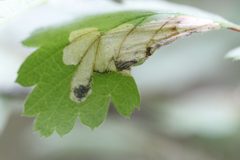
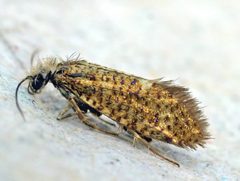
A small of the Eriocraniidae with a wingspan of 10–16 mm, characterized by bronzy-purple forewings sprinkled with pale golden . are active in early spring, flying in sunshine around birch trees from March to April. The larva is a in birch leaves, creating blotch mines with string-like . The is widely distributed across Europe, Asia, and North America, and is closely similar to Eriocrania sangii, requiring genitalia examination for reliable identification.
Pronunciation
How to pronounce Eriocrania semipurpurella: /ˌɛri.oʊˈkreɪniə ˌsɛmɪˌpɜːrpjʊˈrɛlə/
These audio files are automatically generated. While they are not always 100% accurate, they are a good starting point.
Identification
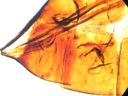
Externally nearly identical to Eriocrania sangii; reliable separation requires microscopic examination of the genitalia. Forewings are elongate, bronzy-purple with variable pale golden sprinkling and an indistinct transverse pale golden spot before the tornus that may be small or obsolete. Hindwings possess hair- except toward the margins, appearing bronzy-grey with purplish tinge posteriorly. Cilia are bronzy-grey, becoming ochreous-whitish at the dorsal spot. Wing venation lacks 9 in the forewing.
Images
Habitat
Associated with birch forests and stands of Betula . fly around birch trees in sunshine, resting on twigs during dull weather. Larval is within birch leaf tissue.
Distribution
Widespread across the Palearctic and Nearctic regions: Europe from Great Britain through northern and central Europe; eastward to Japan; North America from eastern Ontario east to Nova Scotia and south to southern New York, with a western subpopulation in southern Alaska and northwestern Washington.
Seasonality
fly from March to April, with timing varying by location. In China, the E. s. alpina shows larval activity from end of March to early May, with third to fourth instars present in May to June.
Diet
Larva feeds as a in birch leaves (Betula ). Specific plants include Betula platyphylla, B. albo-sinensis, and B. utilis in China.
Life Cycle
One per year. are laid on leaf buds. Larvae feed in leaf mines from late March to early May, starting at or near the leaf edge and widening into a blotch mine; is string-like. Larvae have dark markings on the and prothorax that lighten with maturity. occurs in a tough silken cocoon in the soil, where the overwinters.
Behavior
fly actively in sunshine around birch trees, sometimes forming swarms; become quiescent and rest on twigs during overcast conditions. Larvae exhibit leaf-mining , creating blotch mines in birch foliage.
Ecological Role
on birch trees; serves as for including the larval ectoparasitoid Pnigalio eriocraniae (Eulophidae) and ichneumonid that attack cocoons. Heavy have been recorded in birch forests, potentially affecting tree health.
Similar Taxa
- Eriocrania sangiiExternally indistinguishable; requires genitalia dissection and microscopic examination for reliable separation. Both mine birch leaves and share similar .
Sources and further reading
- BugGuide
- Wikipedia
- GBIF taxonomy match
- iNaturalist taxon
- NCBI Taxonomy
- Catalogue of Life
- A new species of Pnigalio (Hymenoptera, Eulophidae) parasitizing Eriocrania semipurpurella alpina (Lepidoptera, Eriocraniidae) in China, with its biology and a key to Chinese known species
- Figures 3-10 from: Li T, Yang Z-Q, Sun S-P, Wang R (2017) A new species of Pnigalio (Hymenoptera, Eulophidae) parasitizing Eriocrania semipurpurella alpina (Lepidoptera, Eriocraniidae) in China, with its biology and a key to Chinese known species. ZooKeys 687: 149-159. https://doi.org/10.3897/zookeys.687.14903
- Figure 11 from: Li T, Yang Z-Q, Sun S-P, Wang R (2017) A new species of Pnigalio (Hymenoptera, Eulophidae) parasitizing Eriocrania semipurpurella alpina (Lepidoptera, Eriocraniidae) in China, with its biology and a key to Chinese known species. ZooKeys 687: 149-159. https://doi.org/10.3897/zookeys.687.14903
- Figures 12-17 from: Li T, Yang Z-Q, Sun S-P, Wang R (2017) A new species of Pnigalio (Hymenoptera, Eulophidae) parasitizing Eriocrania semipurpurella alpina (Lepidoptera, Eriocraniidae) in China, with its biology and a key to Chinese known species. ZooKeys 687: 149-159. https://doi.org/10.3897/zookeys.687.14903
- Figure 1 from: Li T, Yang Z-Q, Sun S-P, Wang R (2017) A new species of Pnigalio (Hymenoptera, Eulophidae) parasitizing Eriocrania semipurpurella alpina (Lepidoptera, Eriocraniidae) in China, with its biology and a key to Chinese known species. ZooKeys 687: 149-159. https://doi.org/10.3897/zookeys.687.14903
- Figure 2 from: Li T, Yang Z-Q, Sun S-P, Wang R (2017) A new species of Pnigalio (Hymenoptera, Eulophidae) parasitizing Eriocrania semipurpurella alpina (Lepidoptera, Eriocraniidae) in China, with its biology and a key to Chinese known species. ZooKeys 687: 149-159. https://doi.org/10.3897/zookeys.687.14903
- The complete mitogenome of Eriocrania semipurpurella alpina Xu, 1990 (Lepidoptera: Eriocraniidae).