
Habrosyne scripta
(Gosse, 1840)
Lettered Habrosyne, Scribe
Habrosyne scripta, commonly known as the Lettered Habrosyne or Scribe, is a in the Drepanidae. It occurs across southern Canada and the northern United States, with two per year. The was first described by Philip Henry Gosse in 1840.
Pronunciation
How to pronounce Habrosyne scripta: //ˌhæbrəˈsaɪni ˈskrɪptə//
These audio files are automatically generated. While they are not always 100% accurate, they are a good starting point.
Identification
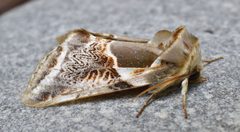
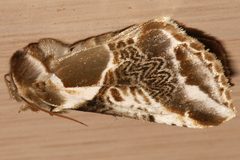
The can be distinguished from similar Habrosyne species by the distinctive script-like patterning on the forewings. The specific epithet 'scripta' refers to these writing-like markings.
Images
Appearance
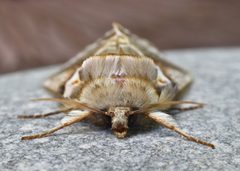
have a wingspan of 30–39 mm. The forewings display intricate, script-like markings that give the its .
Distribution
Southern Canada from Labrador to Vancouver Island; northern United States, extending south in the Appalachians, Ozarks, and Rocky Mountains to North Carolina and Mississippi, and south in the west to Arizona. Distribution records include Alberta, Manitoba, and Saskatchewan in Canada, and Vermont in the United States.
Seasonality
are active from May to August. The has two per year.
Diet
Larvae feed on leaves of Rubus , including black raspberry (Rubus occidentalis) and purple-flowering raspberry (Rubus odoratus). feeding habits are not documented.
Host Associations
- Rubus occidentalis - larval food plantblack raspberry
- Rubus odoratus - larval food plantpurple-flowering raspberry
Life Cycle
Two per year. Larval stage feeds on Rubus leaves. Specific details of , pupal, and stages are not documented in available sources.
Similar Taxa
- Other Habrosyne speciesSimilar overall ; distinguished by forewing pattern details
More Details
Nomenclature
The specific epithet 'scripta' and 'Lettered Habrosyne' and 'Scribe' all reference the distinctive script-like markings on the forewings.
Taxonomic history
Originally described by Philip Henry Gosse in 1840. Some classifications place the Habrosyne in rather than Drepanidae.