
Drepanidae
Hooktip and False Owlet Moths, hook-tip moths
Subfamily Guides
2- Drepaninae(Hooktip Moths)
- Thyatirinae(False Owlet Moths)
is a of comprising approximately 660 described worldwide. The family is divided into three —Drepaninae (hook-tips), Thyatirinae (false owlets), and Cyclidiinae—which share a distinctive type of hearing organ. Many species exhibit a characteristic hook-shaped apex on the forewing, the trait responsible for their . The larvae are notable for their tapered, pointed and a resting posture with both and tail elevated.
Pronunciation
How to pronounce Drepanidae: /drɛpəˈnaɪdiː/
These audio files are automatically generated. While they are not always 100% accurate, they are a good starting point.
Identification
The hooked forewing apex is diagnostic for many Drepaninae . Thyatirinae can be distinguished from Noctuidae by genital and the shared hearing organ structure of . Larval identification relies on the tapered and characteristic resting posture with and tail raised. Precise species identification often requires examination of male genitalia, particularly in with extensive external similarity such as Ditrigona.
Images
Appearance
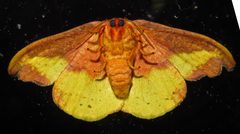
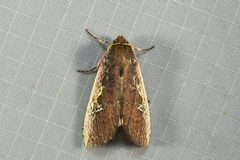
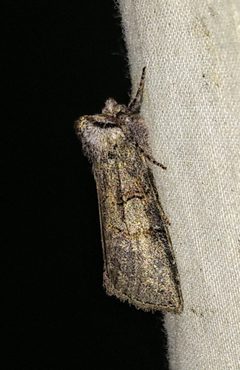
typically possess forewings with a distinctively hooked or falcate apex, particularly pronounced in Drepaninae. Thyatirinae bear superficial resemblance to owlet moths (Noctuidae), often with cryptic patterning. Body size and wing patterns vary considerably across the . Larvae taper to a point at the end, giving them a distinctive profile.
Habitat
Associated with wooded environments including forests and shrublands. Larvae feed on leaves of trees and shrubs, implying dependence on arboreal vegetation. Documented from diverse including the Baikal Lakeshore wet vegetation zone and forested watersheds in northeastern North America.
Distribution
Worldwide distribution with approximately 660 described . Most species exhibit broad geographic ranges spanning Holarctic, Palearctic, Euro-Siberian, and West Palearctic regions. The reaches its greatest diversity in the Oriental region, particularly the Indo-Chinese subregion. Documented from North America (including Massachusetts and Vermont), Europe (Denmark, Norway, Sweden), and Asia (China, Xizang/Tibet, Baikal region of Russia).
Seasonality
are and attracted to light. Seasonal variation in adult form has been documented in some , with distinct spring/early summer and late summer/autumn forms (e.g., in Ditrigona typhodes and D. quinquelineata).
Diet
Larvae feed on leaves of trees and shrubs. Specific plant records are sparse at the level; no feeding habits documented in sources.
Life Cycle
Complete with , larva, pupa, and stages. Larvae pupate between leaves spun together with silk. Specific developmental durations not documented at level.
Behavior
Larvae rest with both and tail raised, a distinctive posture. are and attracted to artificial light sources. Some Thyatirinae exhibit bark-camouflaging coloration and patterning, rendering them inconspicuous on tree trunks.
Ecological Role
Larvae function as folivores on woody vegetation. Specific roles such as pollination, , or are not documented at the level in available sources.
Human Relevance
are encountered by naturalists and enthusiasts at light traps; some draw attention for their distinctive appearance. The has been subject to extensive taxonomic study due to historical classification challenges. No economic importance (pest or beneficial) is documented in sources.
Similar Taxa
- NoctuidaeThyatirinae bear superficial resemblance to owlet moths in general appearance and cryptic patterning, but differ in genital and the structure of the hearing organ shared across .
- GeometridaeSome were historically misplaced in Geometridae; the share some superficial similarities in wing shape and larval form, but Drepanidae larvae have the distinctive tapered and resting posture, and possess the family-characteristic hearing organ.
More Details
Taxonomic History
The Thyatirinae was previously treated as a separate but is now included in based on shared morphological characters, particularly the type of hearing organ. The Ditrigona was substantially revised, with count increasing from 2 to 52 through description of new and synonymy of related genera.
Hearing Organ
All three share the same type of hearing organ, a unifying morphological feature of the .
Sources and further reading
- BugGuide
- Wikipedia
- GBIF taxonomy match
- iNaturalist taxon
- Catalogue of Life
- Bug Eric: More moth fashions
- Bug Eric: June 2009
- A taxonomic revision of the genus Ditrigona (Lepidoptera: Drepanidae: Drepaninae)
- TO FAUNA AND ECOLOGY OF MOTHS (LEPIDOPTERA: THYATIRIDAE, DREPANIDAE, GEOMETRIDAE) OF BAIKAL LAKE SHORE OF BAIKAL NATURE RESERVE
- Two new species of Thymistadopsis Walker, 1865, and one new record from Xizang, China (Lepidoptera, Drepanidae, Drepaninae)
- Review of the genus Tridrepana Swinhoe, 1895 (Lepidoptera, Drepanidae: Drepaninae) from Xizang, China
- Review of the Afrotropical Thyatirinae (Lepidoptera, Drepanidae) with description of a new genus and a new species
- The genome sequence of the Barred Hook-tip, Watsonalla cultraria (Fabricius, 1775) (Lepidoptera: Drepanidae).