
Drepana arcuata
Walker, 1855
Arched Hooktip Moth, masked birch caterpillar
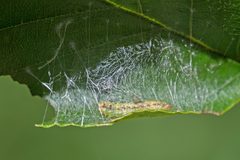
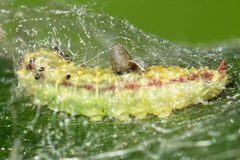
Drepana arcuata, commonly known as the arched hooktip , is a North American in the hooktip moth Drepanidae. are active from mid-May through late July, with one per year in northern . The species is notable for its larvae, which produce sounds through body vibrations, drumming, scraping mouthparts, and specialized anal structures—possibly to communicate and attract other larvae to communal silk shelters.
Pronunciation
How to pronounce Drepana arcuata: /dɹəˈpeɪnə ɑɹˈkjuːətə/
These audio files are automatically generated. While they are not always 100% accurate, they are a good starting point.
Identification
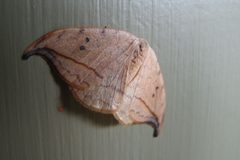
The arched or hooked forewing tip distinguishes this from most other Lepidoptera. Within Drepanidae, separation from requires examination of genitalia or other subtle morphological features not detailed in available sources.
Images
Appearance
have a wingspan of 24–40 mm. The forewings exhibit a distinctive arched or hooked tip, characteristic of the Drepana. Coloration and detailed wing patterns are not specified in available sources.
Habitat
Associated with plants Betula papyrifera (paper birch) and Alnus (alders), suggesting riparian or mixed deciduous forest environments where these trees occur.
Distribution
Transcontinental in North America: from Newfoundland to Vancouver Island, southward to at least North Carolina, South Carolina, and California. Specific distribution records include Alberta, Manitoba, and Saskatchewan in Canada, and Vermont in the United States.
Seasonality
on wing from mid-May through late July. One per year in northern parts of range.
Diet
Larvae feed on Betula papyrifera (paper birch) and Alnus (alders). feeding habits are not documented.
Host Associations
- Betula papyrifera - larval food plantpaper birch
- Alnus - larval food plantalders
Life Cycle
One per year in northern . Larval stage constructs communal silk shelters. Detailed description of , pupae, or stage not available.
Behavior
Larvae are known to produce sounds through multiple mechanisms: shaking their bodies, drumming and scraping mouthparts against the substrate, and dragging specialized anal 'oars' against leaf surfaces. These sounds may function to attract other larvae to existing communal silk shelters.
Ecological Role
Larval herbivore on birch and alder. Communal shelter-building suggests potential for localized defoliation. Specific ecological impacts not quantified.
Human Relevance
No documented economic or medical significance. Of interest to entomologists for its unusual larval .
Similar Taxa
- Other Drepana speciesShare hooked forewing tips; require detailed morphological examination for separation
More Details
Acoustic communication
The sound-producing of Drepana arcuata larvae is relatively well-documented among Lepidoptera. The use of specialized anal 'oars' combined with mouthpart and body vibration mechanisms represents a complex multimodal signaling system, the full function of which remains under study.
Communal behavior
Larvae construct and occupy communal silk shelters, a that may facilitate , defense, or improved foraging . The acoustic signals appear to play a role in aggregating conspecifics to these shelters.