
Drepana
Schrank, 1802
hook-tip moths
Species Guides
2- Drepana arcuata(Arched Hooktip Moth)
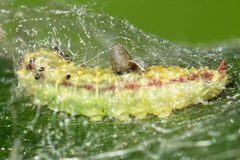
- Drepana bilineata(warty birch caterpillar)
Drepana is a of hook-tip moths in the Drepanidae, Drepaninae. The genus includes with distinctive falcate (sickle-shaped) forewings that give the group its . Larvae are folivorous, feeding primarily on birch and alder. Some species exhibit notable during larval territorial contests. are and fly primarily in spring and summer.
Pronunciation
How to pronounce Drepana: /dɹɪˈpɑːnə/
These audio files are automatically generated. While they are not always 100% accurate, they are a good starting point.
Identification
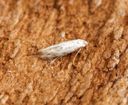
Hook-tip moths in the Drepana are distinguished by their falcate forewing tips, which curve outward in a sickle or hook shape. This wing shape is diagnostic for the genus and . Specific identification requires examination of wing pattern, coloration, and genitalia. Drepana falcataria (Pebble Hook-tip) is the largest and commonest species in Britain and Ireland, with a distinct northern D. f. scotica characterized by paler ground color.
Images
Habitat
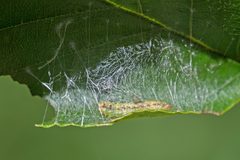
Woodlands, gardens, and heathland. Larval consists of birch and alder leaves where they establish and defend feeding territories.
Distribution
Britain and Ireland (widespread and common, though declined in abundance since 1970s); western and central Europe; Siberia. Drepana falcataria has expanded its range since 1970 but decreased in abundance. Northern Scotland a distinct with localized distribution.
Seasonality
fly at night from late April to June, with a second peaking in August in southern parts of the range. Northern have a single . Spring generation has shifted significantly earlier since the 1970s.
Diet
Larvae feed on birch (Betula spp.) and alder (Alnus glutinosa). do not feed.
Host Associations
- Betula spp. - larval food plantprimary
- Alnus glutinosa - larval food plantsecondary
Life Cycle
Over-winters as pupa. Larvae develop through multiple instars, establishing feeding territories on leaves. occurs in a cocoon. emerge in spring, with second in late summer where climate permits.
Behavior
Larvae of at least two (D. bilineata and D. arcuata) exhibit vibration-mediated territoriality. They produce substrate-borne vibrations through drumming (striking the leaf with open ) and anal scraping (dragging specialized oar-shaped setae against the leaf surface). These vibrations function as honest signals of body size, allowing rivals to assess opponents and resolve contests without physical combat. Residents signal more frequently than intruders, with signaling rate increasing as intruders approach. are and attracted to light.
Ecological Role
Larvae are folivores on birch and alder, contributing to nutrient cycling in woodland . Their territorial may influence leaf resource partitioning among conspecifics.
Human Relevance
Subject of ecological research on in insects. Drepana falcataria is among the whose has been tracked as evidence of climate change effects, with spring shifting earlier since the 1970s.
Similar Taxa
- Other Drepanidae generaSimilar falcate wing shape; distinguished by specific wing pattern, size, and genitalia characters
- Falcaria (other hook-tip moths)Similar wing shape and ; Falcaria bilineata was formerly placed in Drepana as D. bilineata but has been reclassified based on morphological differences