
Carmenta verecunda
(Edwards, 1881)
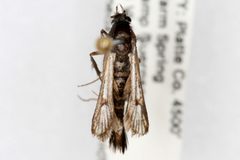
Carmenta verecunda is a clearwing moth in the Sesiidae, described by Henry Edwards in 1881. It occurs in the western United States, with records from Colorado, Utah, California, and Arizona. The is a herbivore whose larvae feed on Lithospermum ruderale, a plant in the borage family. Like other clearwing moths, it exhibits -mimicry in its form.
Identification
Carmenta verecunda can be distinguished from other clearwing moths by geographic distribution and plant association. Within its range, it may be separated from similar western Carmenta by details of wing pattern and genitalia, though specific diagnostic characters require examination. The species is known to occur sympatrically with other Carmenta species in parts of its range.
Images
Appearance
are clearwing moths with reduced wing scaling that creates transparent areas on the wings, a characteristic trait of the Sesiidae. The body is typically -like in form, with dark coloration and often pale or yellowish markings. Specific pattern details for C. verecunda are not well documented in available sources.
Habitat
Associated with supporting its larval plant Lithospermum ruderale, which grows in dry, open areas including grasslands, sagebrush steppe, and open woodlands in western North America.
Distribution
Western United States: recorded from Colorado, Utah, California, and Arizona. GBIF records also indicate occurrence in Alberta and Manitoba, Canada, extending the known range northward into the Canadian prairies.
Diet
Larvae feed on Lithospermum ruderale (borage , Boraginaceae). feeding habits are not documented.
Host Associations
- Lithospermum ruderale - larval food plantNative herb of western North America
Life Cycle
Complete with , larval, pupal, and stages. Larvae are borers in the roots or stems of the plant. Specific details of development timing and stage are not documented.
Behavior
are and likely engage in -mimicry , a common trait in clearwing moths that reduces . Specific behavioral observations for this are not recorded.
Ecological Role
As a herbivore, larvae contribute to nutrient cycling through their feeding on Lithospermum ruderale. The participates in mimicry complexes involving Hymenoptera, potentially affecting learning and dynamics.
Similar Taxa
- Carmenta wildishorumAnother western North American Carmenta ; distinguished by more recent description (2017) and different geographic range centered on New Mexico and Colorado
- Other Carmenta speciesMany Carmenta are morphologically similar and require examination of genitalia or for definitive identification; plant association provides a useful clue for C. verecunda
More Details
Original description
First described as Aegeria verecunda by Henry Edwards in 1881, later transferred to Carmenta.
Taxonomic note
The epithet 'verecunda' is Latin for 'modest' or 'bashful', though the reason for this choice was not stated in the original description.