
Tebenna silphiella
rosinweed moth
Tebenna silphiella is a small in the Choreutidae, commonly known as the rosinweed moth. It is restricted to prairie in the central United States, where its larvae feed exclusively on Silphium integrifolium (rosinweed). The has two per year, with active in May and larvae present from May through June.
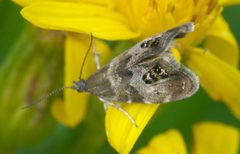
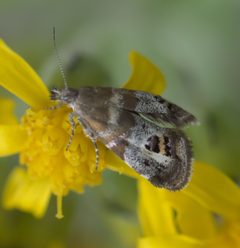
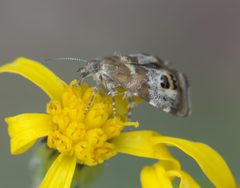
Pronunciation
How to pronounce Tebenna silphiella: /tɛˈbɛnə sɪlˈfɪɛlə/
These audio files are automatically generated. While they are not always 100% accurate, they are a good starting point.
Identification
A small choreutid . Specific diagnostic features distinguishing it from other Tebenna are not documented in available sources.
Images
Habitat
Prairies and meadows.
Distribution
Central United States, specifically recorded from Wisconsin, Illinois, and Colorado.
Seasonality
on wing from early to late May. Two per year.
Diet
Larvae feed on Silphium integrifolium (rosinweed), skeletonizing the upper leaves of the plant.
Host Associations
- Silphium integrifolium - larval plantLarvae skeletonize leaves, almost always feeding on top leaves at or near the apex
Life Cycle
Two per year. Full-grown larvae reach approximately 12 mm in length. Larvae recorded from May to June.
Behavior
Larvae feed on the uppermost leaves of their plant, skeletonizing the foliage.