
Brenthia pavonacella
Clemens, 1860
peacock brenthia moth
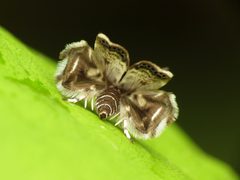
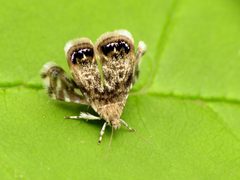
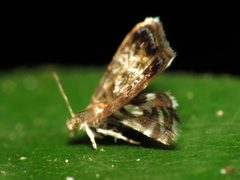
A small in the Choreutidae, measuring approximately 9 mm in wingspan. The exhibits at least two annually in Illinois, with larval activity documented from early July to early September. Known for its distinctive wing patterns that have been proposed to function in mimicry, deterring jumping spider attacks.
Pronunciation
How to pronounce Brenthia pavonacella: /ˈbrɛn.θi.a ˌpæ.vəˈneɪ.sɛl.ə/
These audio files are automatically generated. While they are not always 100% accurate, they are a good starting point.
Identification
Distinguished from other Choreutidae by its small size (wingspan ~9 mm) and the characteristic wing patterning typical of the Brenthia. Members of this genus display underside wing patterns that resemble the and legs of an oncoming jumping spider, a trait that may serve as a defensive against . Specific identification to level likely requires examination of genitalia or detailed wing pattern analysis.
Images
Habitat
Associated with plants in the Desmodium (Fabaceae), suggesting occurrence in open, disturbed where these legumes grow, including prairies, forest edges, and agricultural margins.
Distribution
North America: documented from Illinois, Maryland, Iowa, Oklahoma, South Carolina, and Mexico. The disjunct distribution pattern suggests potential for broader occurrence in suitable across the eastern and central United States.
Seasonality
Multivoltine with at least two per year in Illinois. active during summer months; larvae present from early July to early September.
Diet
Larvae feed on Desmodium sp. (Fabaceae). feeding habits are not documented.
Host Associations
- Desmodium sp. - larval Fabaceae; documented in Illinois
Life Cycle
At least two per year in Illinois. Larval stage occurs from early July to early September, suggesting and patterns tied to seasonal progression. Complete with , larval, pupal, and adult stages.
Behavior
may display wing patterns in a manner that enhances mimicry, presenting the illusion of a jumping spider to potential predators. This has been documented in and represents a proposed defensive strategy.
Ecological Role
Herbivore in larval stage, potentially contributing to of Desmodium . The proposed mimicry in suggests a role in predator-prey interaction dynamics, potentially influencing local jumping spider foraging .
Similar Taxa
- Other Brenthia speciesSimilar size, wing shape, and characteristics; identification requires detailed examination of wing pattern elements and genitalia
- Other Choreutidae generaSmall size and general overlap; Brenthia distinguished by specific wing pattern elements and proposed spider-mimicry adaptations