
Manduca occulta
Rothschild & Jordan, 1903
Occult Sphinx
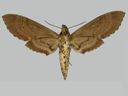
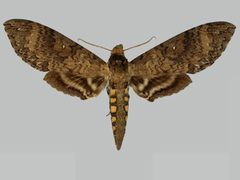
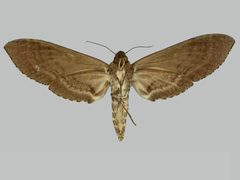
Manduca occulta, the occult sphinx, is a large sphinx moth in the Sphingidae. have a wingspan of 105–120 mm and are visually similar to Manduca diffissa tropicalis, requiring genital examination for definitive identification. The occurs from Panama through Central America and Mexico to the southern United States, with occasional strays reaching southern Florida. It completes one per year in Rica, with adults active from May to June.
Pronunciation
How to pronounce Manduca occulta: //ˈmæn.djʊ.kə ɒkˈʊl.tə//
These audio files are automatically generated. While they are not always 100% accurate, they are a good starting point.
Identification
Distinguished from the very similar Manduca diffissa tropicalis only by examination of genitalia. The brownish-black bands on the hindwing underside are a visible feature that may aid in field recognition, though this trait alone is insufficient for definitive identification.
Images
Distribution
Panama north through Central America (Belize, Guatemala, Nicaragua, Rica) and Mexico to southern Arizona; occasional strays recorded in southern Florida.
Seasonality
One per year in Rica, with on wing May to June. In Nicaragua, adults recorded July to August and October. Strays in Florida recorded in September.
Diet
feed on nectar of various flowers. Larvae feed on Cestrum glanduliferum, Cestrum racemosum, Solanum accrescens, and Solanum hazenii.
Host Associations
- Cestrum glanduliferum - larval food plant
- Cestrum racemosum - larval food plant
- Solanum accrescens - larval food plant
- Solanum hazenii - larval food plant
Life Cycle
One per year in Rica. Larval development and details not documented in available sources.
Similar Taxa
- Manduca diffissa tropicalisExtremely similar external ; distinguished only by genital examination
More Details
Taxonomic history
Originally described as Protoparce occulta by Rothschild & Jordan in 1903, later transferred to Manduca.
Sources and further reading
- BugGuide
- Wikipedia
- GBIF taxonomy match
- iNaturalist taxon
- NCBI Taxonomy
- Catalogue of Life
- The Hornworms Are Not Your Friends | Bug Squad
- California Dogface Butterfly Steals the Show | Bug Squad
- Insect FAQs | Entomology Research Museum
- Tough to be a hornworm: Tomato and tobacco hornworms, Manduca quinquemaculata and M. sexta — Bug of the Week
- Advanced Morphology Techniques Reveal Tobacco Hornworm's Secrets
- Scientists Sequence the Genome of the Tobacco Hornworm