
Xylophanes pluto
Fabricius, 1777
Pluto sphinx
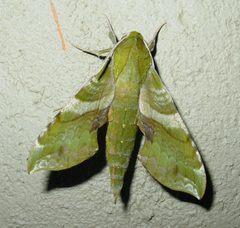
Xylophanes pluto, commonly known as the Pluto sphinx, is a hawkmoth in the Sphingidae. It is distinguished from by a prominent broad chrome-yellow band across the wings. The occurs from Argentina northward through Central America to the southern United States, with multiple per year in Florida and Texas and year-round activity in tropical regions. Larvae feed on specific plants including Chiococca, Erythroxylum, Hamelia patens, and Morinda royoc.
Pronunciation
How to pronounce Xylophanes pluto: /zɪˈlɒfəniːz ˈpluːtoʊ/
These audio files are automatically generated. While they are not always 100% accurate, they are a good starting point.
Identification
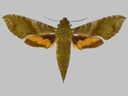
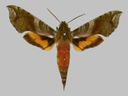
The broad chrome-yellow band on the forewing is diagnostic and separates Xylophanes pluto from all other in the . The combination of green , maize yellow with metallic yellow scaling, and interrupted medial line with segmental dots provides additional distinguishing characters. Wing shape and body proportions typical of Xylophanes hawkmoths.
Images
Appearance
Medium-sized hawkmoth with wingspan 53–65 mm. Forewings display a prominent broad chrome-yellow band that distinguishes this from all other Xylophanes. green. with thin medial line interrupted at base of each segment by metallic yellow dot; lateral lines present. Thorax and abdomen maize yellow with metallic yellow ; a few metallic yellow scales also present dorso-laterally.
Habitat
Tropical and subtropical lowlands. In the United States, restricted to southern Florida and southern Texas. Occupies diverse lowland throughout its range including forest edges, gardens, and disturbed areas where plants occur.
Distribution
Native to the Americas. Range extends from Argentina and Paraguay north through Bolivia and tropical/subtropical lowlands of Brazil, continuing through Central America to Mexico, the West Indies, southern Florida, and southern Texas. Distribution records confirmed from multiple Brazilian states including Amapá, Distrito Federal, Espírito Santo, Maranhão, Minas Gerais, Mato Grosso, Pará, Paraíba, Pernambuco, Paraná, Rio de Janeiro, Roraima, Rio Grande do Sul, Santa Catarina, and São Paulo.
Seasonality
Multiple per year in Florida and Texas. active year-round in tropical portions of the range.
Diet
Larvae feed on Chiococca , Erythroxylum species, Hamelia patens (firebush), and Morinda royoc. feeding habits not specified in available sources.
Host Associations
- Chiococca - larval foodplant in Rubiaceae
- Erythroxylum - larval foodplant in Erythroxylaceae
- Hamelia patens - larval foodplant firebush, Rubiaceae
- Morinda royoc - larval foodplant Rubiaceae
Life Cycle
Multiple per year in temperate portions of range (Florida, Texas). Continuous breeding with year-round activity in tropics. Complete with , larva, pupa, and adult stages; specific details of and not documented in available sources.
Behavior
are . typical of sphingid with rapid, agile flight. Specific behavioral details beyond flight activity patterns not documented in available sources.
Ecological Role
likely serve as . Larvae function as herbivores on their specific plants. Role in as prey for birds, bats, and other inferred from -level traits but not specifically documented.
Human Relevance
Occasional visitor to gardens in southern Florida and Texas where larval plants are cultivated. No significant economic importance documented. Subject of interest to lepidopterists and naturalists.
Similar Taxa
- Other Xylophanes speciesLack the diagnostic broad chrome-yellow forewing band; may share green and yellowish abdominal coloration but wing pattern differs
More Details
Taxonomic history
Originally described as Sphinx pluto by Johan Christian Fabricius in 1777; later transferred to Xylophanes. Basionym Sphinx pluto.
Sources and further reading
- BugGuide
- Wikipedia
- GBIF taxonomy match
- iNaturalist taxon
- NCBI Taxonomy
- Catalogue of Life
- In Search of the World's Biggest Bee: How It Came to 'Bee' | Bug Squad
- How to import occurrence records into manuscripts from GBIF, BOLD, iDigBio and PlutoF | Blog
- beetle species | Blog
- Truffles and tulips: Pensoft and the 12th International Mycological Congress |