
Proserpinus flavofasciata
Walker, 1856
yellow-banded day sphinx
Proserpinus flavofasciata, commonly known as the yellow-banded day sphinx, is a day-flying hawk moth native to North America. The is a bumblebee mimic with distinctive black and yellow coloration. The inhabits and mountain forest edges and clearings, with a distribution spanning Canada from Alaska to the Maritimes and southward to Maine and Massachusetts. Larvae feed on Epilobium and Rubus species, and the species overwinters as a pupa in soil.
Pronunciation
How to pronounce Proserpinus flavofasciata: /prɒˈsɛrpɪnəs ˌfleɪvoʊfæʃiˈeɪtə/
These audio files are automatically generated. While they are not always 100% accurate, they are a good starting point.
Identification
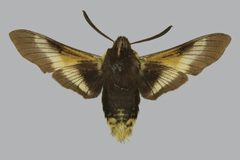
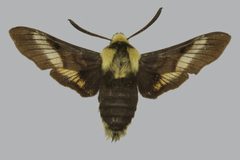
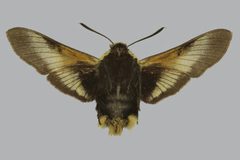
Distinguished from other Proserpinus by the prominent yellow band on black hindwings combined with the pale band on black forewings. Day-flying and bumblebee-mimic appearance separate it from most other sphingid , which are primarily . The combination of black body with yellow markings and specific wing pattern is diagnostic.
Images
Habitat
Edges and clearings of forests and mountain forests. Occurs in forest openings where larval plants grow.
Distribution
Canada: widespread including Alberta, Manitoba, Saskatchewan; Alaska in the west; Maritime provinces in the east. United States: south to Maine and Massachusetts in the east. More common in western portions of its range.
Seasonality
fly in late spring and early summer. Larvae develop through summer. Overwinters as pupa in soil.
Diet
Larva feeds on various Epilobium and Rubus , including Rubus parviflorus. feeding habits not described in sources.
Host Associations
- Epilobium - larval food plantvarious
- Rubus parviflorus - larval food plant
- Rubus - larval food plantvarious
Life Cycle
and early instars not described. Larva develops through several instars with dramatically different appearances between and final instars. Pupates in soil and overwinters in this stage. Voltinism not specified in sources.
Behavior
are day-flying, unusual among Sphingidae. Adults have been observed to fly with urgency but specific patterns or other not detailed. activity not reported.
Ecological Role
Larva acts as herbivore on Epilobium and Rubus. may function as during day ; specific interactions not documented. Serves as prey for various ; bumblebee mimicry likely provides protective advantage.
Human Relevance
Collected by entomologists; one specimen reportedly used in trade between collectors in the 1980s. No economic significance documented. Not known to be a pest.
Similar Taxa
- Proserpinus gauraeCongeneric day-flying sphingid with similar bumblebee-mimic appearance; distinguished by wing pattern details and geographic distribution
- Bombus speciesMimicry target; resemble bumblebees in and general appearance but distinguished by wing structure and upon close inspection
More Details
Mimicry
The 's bumblebee-like appearance represents , gaining protection from that avoid stinging Hymenoptera.
Western abundance
The is notably more common in the western portion of its range compared to eastern .