
Cautethia
Grote, 1865
Species Guides
2- Cautethia grotei(Grote's sphinx)
- Cautethia spuria(Spurious Sphinx)
Cautethia is a of sphinx moths (Sphingidae) established by Augustus Radcliffe Grote in 1865. The genus comprises seven described distributed primarily in the Caribbean region and southeastern United States. These belong to the tribe Dilophonotini within the Macroglossinae, a group characterized by streamlined bodies and rapid .
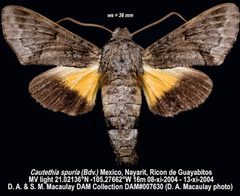
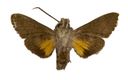
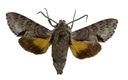
Pronunciation
How to pronounce Cautethia: /kaʊˈtɛθiə/
These audio files are automatically generated. While they are not always 100% accurate, they are a good starting point.
Identification
Members of Cautethia can be distinguished from related dilophonotine by genitalic characters, particularly the structure of the male claspers and . The genus is characterized by relatively small size compared to many sphingids, with forewing lengths generally under 25 mm. Wing patterns tend toward subdued brown or gray tones with reduced maculation compared to more sphingid genera.
Images
Habitat
occur in coastal and insular , including pine woodlands, scrublands, and tropical dry forests. Several species are restricted to specific island systems in the Bahamas and Caribbean.
Distribution
Primarily Caribbean, with records from the Bahamas, Cuba, Hispaniola, Jamaica, Puerto Rico, and the Yucatán Peninsula. Cautethia noctuiformis extends into the southeastern United States (Florida, coastal Georgia).
Similar Taxa
- ErinnyisSimilar small to medium sphingid with streamlined bodies; distinguished by differences in wing venation and male genitalia structure
- DilophonotusRelated in the same tribe Dilophonotini; separated by differences in forewing shape and abdominal patterning
More Details
Taxonomic History
Grote originally described the in 1865, though some sources cite 1867. The type , Cautethia noctuiformis, was described earlier by Walker in 1856 under the name Macrosila noctuiformis.