
Madoryx pseudothyreus
Grote, 1865
False-windowed Sphinx
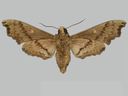
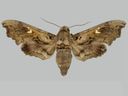
Madoryx pseudothyreus, the false-windowed sphinx, is a hawkmoth in the Sphingidae. The was described by Augustus Radcliffe Grote in 1865. It occurs in southern Florida, Cuba, and surrounding Caribbean islands. The refers to its resemblance to the windowed sphinx (Madoryx oiclus), from which it can be distinguished by subtle wing pattern differences.
Pronunciation
How to pronounce Madoryx pseudothyreus: /məˈdɔrɪks ˌsjuːdoʊˈθaɪriəs/
These audio files are automatically generated. While they are not always 100% accurate, they are a good starting point.
Identification
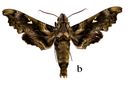
Distinguished from the windowed sphinx (Madoryx oiclus) by the absence of a pale, contrasting patch on the forewing upperside. In M. pseudothyreus, the forewing is more uniformly brown with darker markings, whereas M. oiclus shows a distinct pale area. Genitalia examination may be required for definitive identification of worn specimens. From other Madoryx , it differs in wing pattern details and geographic distribution.
Images
Appearance
Medium-sized hawkmoth with narrow, elongated forewings and a streamlined body typical of the . Forewing upperside is brown with darker markings; the pattern lacks the distinct pale 'window' patch found in the closely related Madoryx oiclus. Hindwings are narrower than forewings. Body is robust with a tapering . Resting posture holds wings flat or slightly tented over the body.
Habitat
Tropical and subtropical environments in the Caribbean region, including coastal and inland areas of southern Florida, Cuba, and neighboring islands. Specific microhabitat preferences are poorly documented but likely includes areas supporting larval plants.
Distribution
Southern tip of Florida, USA; Cuba; and surrounding West Indies islands. Records indicate presence throughout the Caribbean region.
Ecological Role
are likely , though specific floral associations are not documented. Larvae, if herbivorous as in related , would function as primary consumers.
Similar Taxa
- Madoryx oiclusWindowed sphinx; distinguished by presence of pale 'window' patch on forewing versus uniformly dark forewing in M. pseudothyreus. Both occur in overlapping ranges in the Caribbean.
More Details
Taxonomic history
Originally described as Hemeroplanes pseudothyreus by Grote in 1865, later transferred to Madoryx. The basionym reflects early confusion in sphingid generic limits.