
Agapema anona
(Ottolengui, 1903)
greasewood silkmoth, Mexican agapema, Condalia Silk Moth
Species Guides
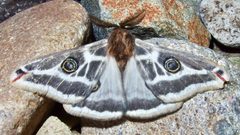
1Agapema anona is a giant silkmoth in the Saturniidae, found in the southwestern United States and northern Mexico. Larvae feed exclusively on plants in the Condalia, while lack functional mouthparts and do not feed. The inhabits arid environments including desert foothills and alluvial fans. Three are recognized, distinguished by geographic distribution.
Pronunciation
How to pronounce Agapema anona: /ˌæɡəˈpiːmə əˈnoʊnə/
These audio files are automatically generated. While they are not always 100% accurate, they are a good starting point.
Identification
are large silkmoths with reduced or non-functional mouthparts, a characteristic of the Saturniidae. The can be distinguished from other Agapema species by its association with Condalia plants and its range in the southwestern United States and northern Mexico. identification requires examination of geographic origin and subtle morphological differences.
Images
Habitat
Plains, plateaus, desert foothills, arroyos, and alluvial fans in arid and semi-arid regions.
Distribution
Southern Arizona, Texas, and New Mexico, extending into northern Mexico.
Diet
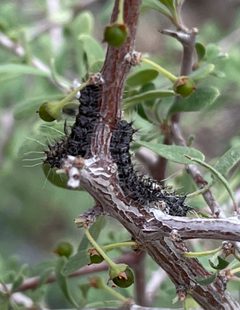
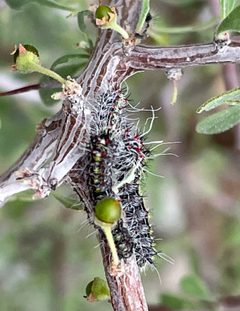
Larvae feed on Condalia , specifically knife-leaf condalia (Condalia spathulata), green snakewood (Condalia viridis), and javelina bush (Condalia ericoides). do not feed.
Host Associations
- Condalia spathulata - larval knife-leaf condalia
- Condalia viridis - larval green snakewood
- Condalia ericoides - larval javelina bush
Life Cycle
Complete with , larva, pupa, and stages. Larval development occurs on Condalia plants. Adults emerge and reproduce without feeding.
Behavior
are and attracted to light. Larvae are feeders on Condalia .
Ecological Role
Larvae function as herbivores on Condalia shrubs in desert . may serve as prey for .
Human Relevance
The is of interest to lepidopterists and naturalists. Its MONA/Hodges number is 7754.1.
Similar Taxa
- Other Agapema speciesDistinguished by plant specificity and geographic range; other in the occur in different regions and may utilize different host plants.
- Other SaturniidaeShared characteristics include large size, reduced mouthparts, and silkmoth ; distinguished by -level traits and associations.
More Details
Subspecies
Three are recognized: Agapema anona anona (Ottolengui, 1903), Agapema anona dyari (Cockerell, 1914), and Agapema anona platensis (Peigler & Kendall, 1993), with MONA/Hodges numbers 7754.1, 7754.2, and 7754.3 respectively.
Taxonomic Note
The was originally described as Saturnia anona by Ottolengui in 1903 and later transferred to the Agapema. GBIF lists the name as a synonym under Saturnia anona, though NCBI and other sources recognize Agapema anona as the valid name.